Everything Capable can do, organised by what it's for.
Capable is a capability measurement platform organised around four pillars — produce evidence, make sense of it, plan growth, keep the practice accountable. This page is the catalogue. Each pillar links through to a deeper page where the surfaces live in detail.
Designing and running the work that produces evidence of capability.
The instrument library and the programmes that orchestrate it. Pick one instrument for one decision, or sequence several around the same person or cohort.
SFIA interview
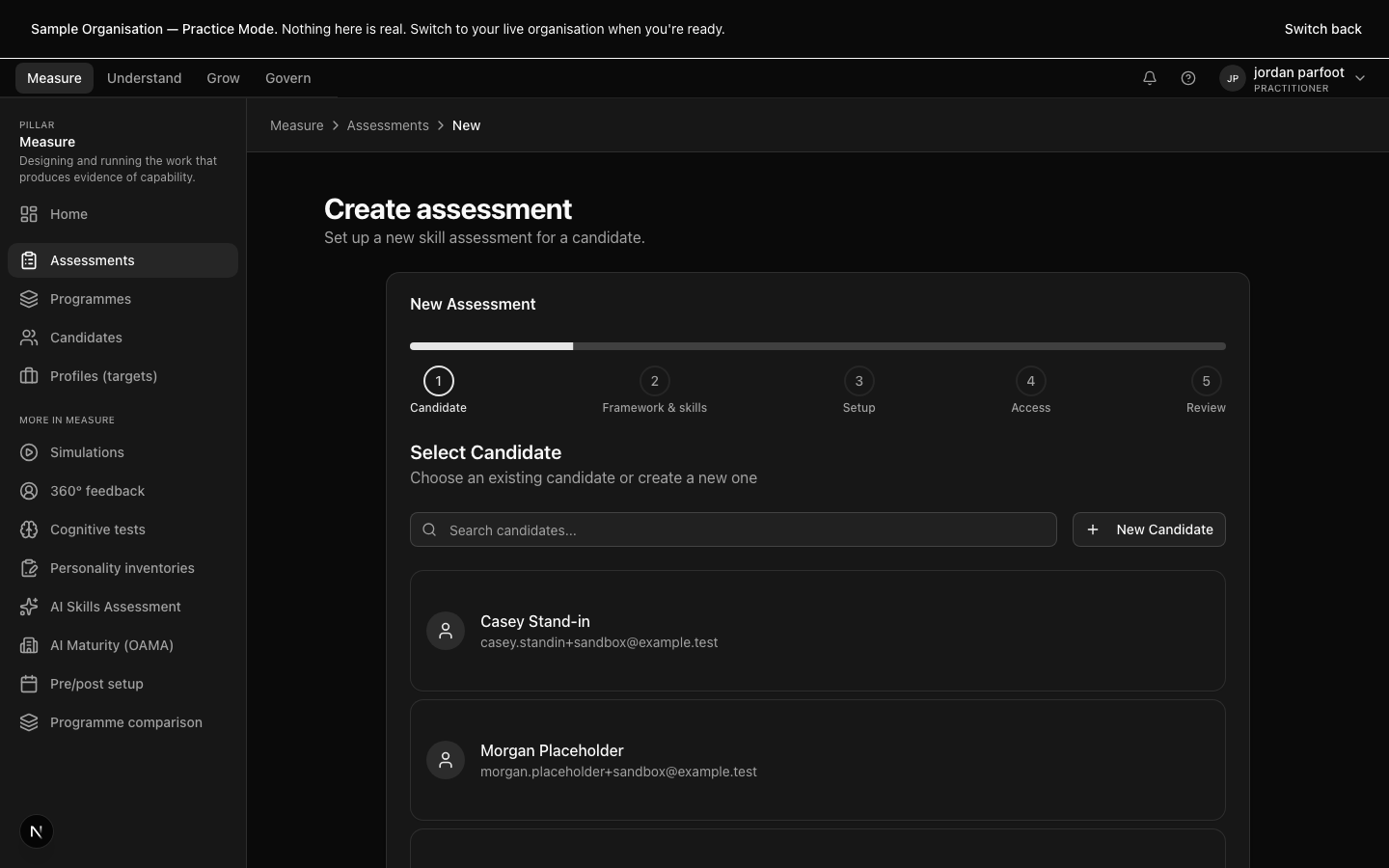
SFIA interview
Ava, the platform's AI interviewer, runs a structured competency conversation against the SFIA 9 framework or a custom one.
Multi-instrument programmes
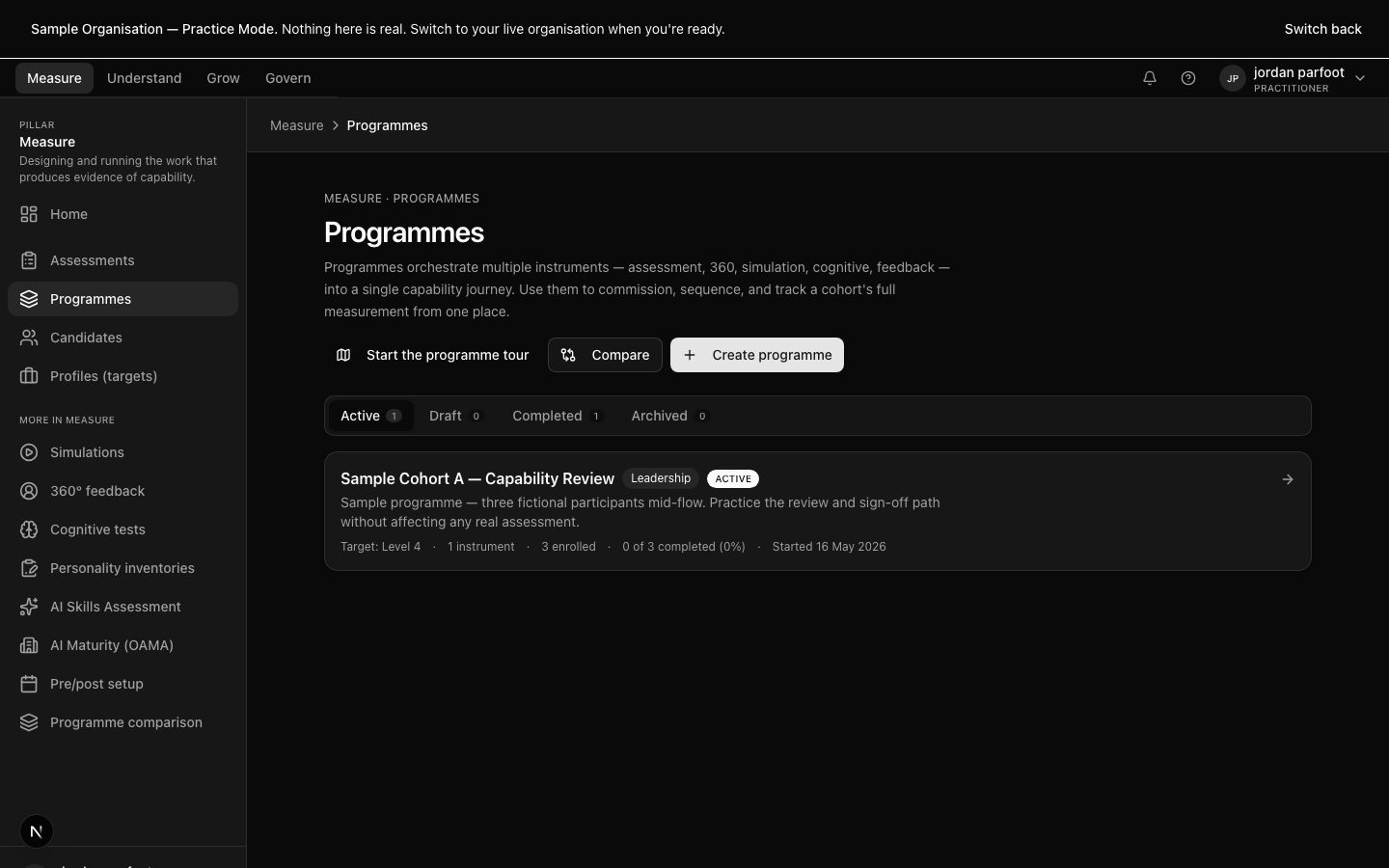
Multi-instrument programmes
Sequence interviews, simulations, cognitive tests, 360s, and feedback sessions around one person or one cohort. One consent envelope, one report.
In-tray simulation

In-tray simulation
A timed inbox-triage exercise — judgement under volume, with the participant's actions captured as evidence.
Role-play simulation

Role-play simulation
A multi-turn conversation with an AI persona — handling a difficult stakeholder, coaching a team member, negotiating a constraint.
Analysis-presentation simulation

Analysis-presentation simulation
A brief, time-boxed analysis followed by a recommendation to a simulated panel — written then verbal.
Group exercise

Group exercise
A leaderless group task with structured observer rating — collaboration evidence under realistic constraints.
Cognitive ability test
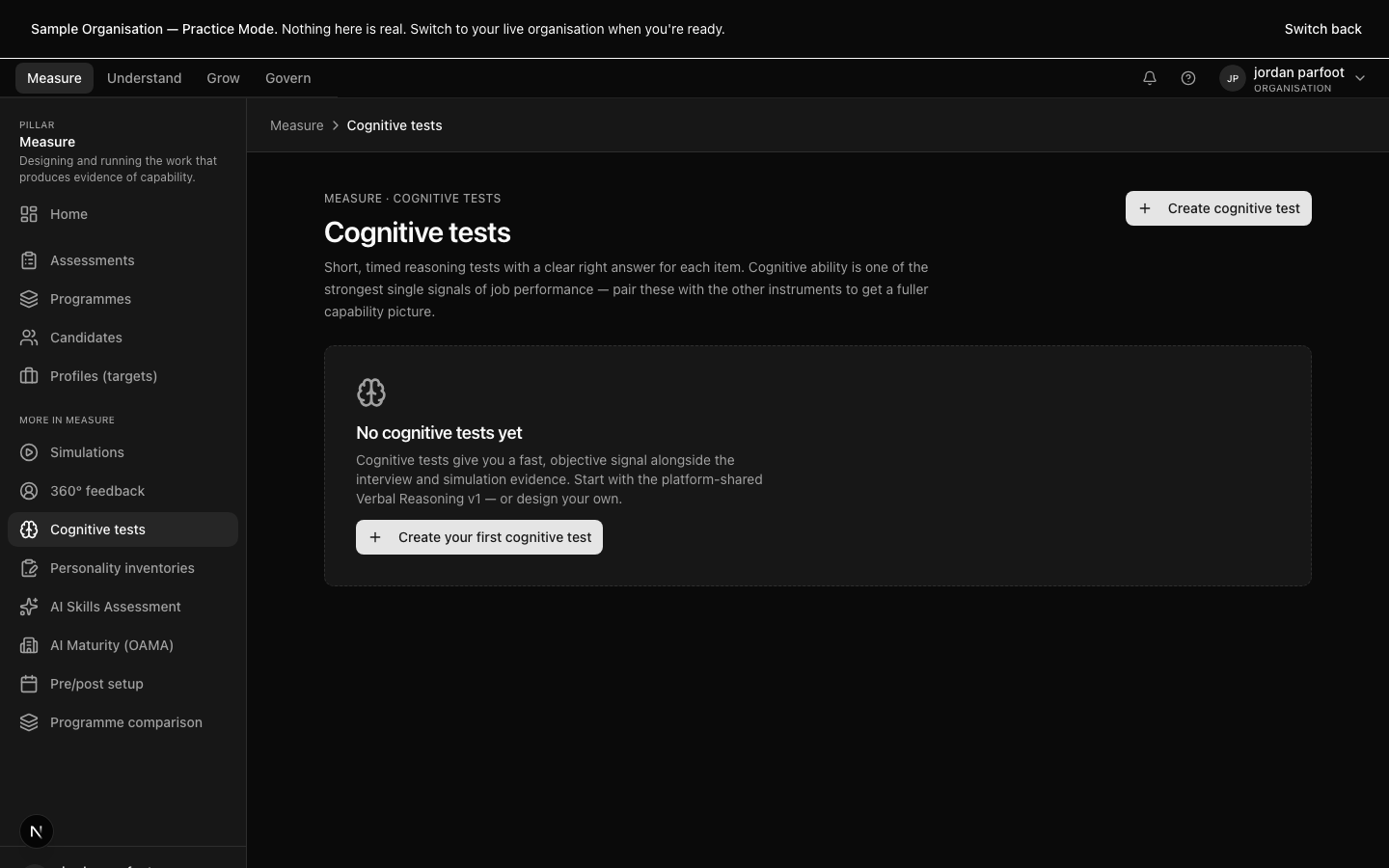
Cognitive ability test
Verbal reasoning today, with numerical, abstract, and situational-judgement variants to follow. Adaptive item-by-item with reliability flags.
Personality inventory
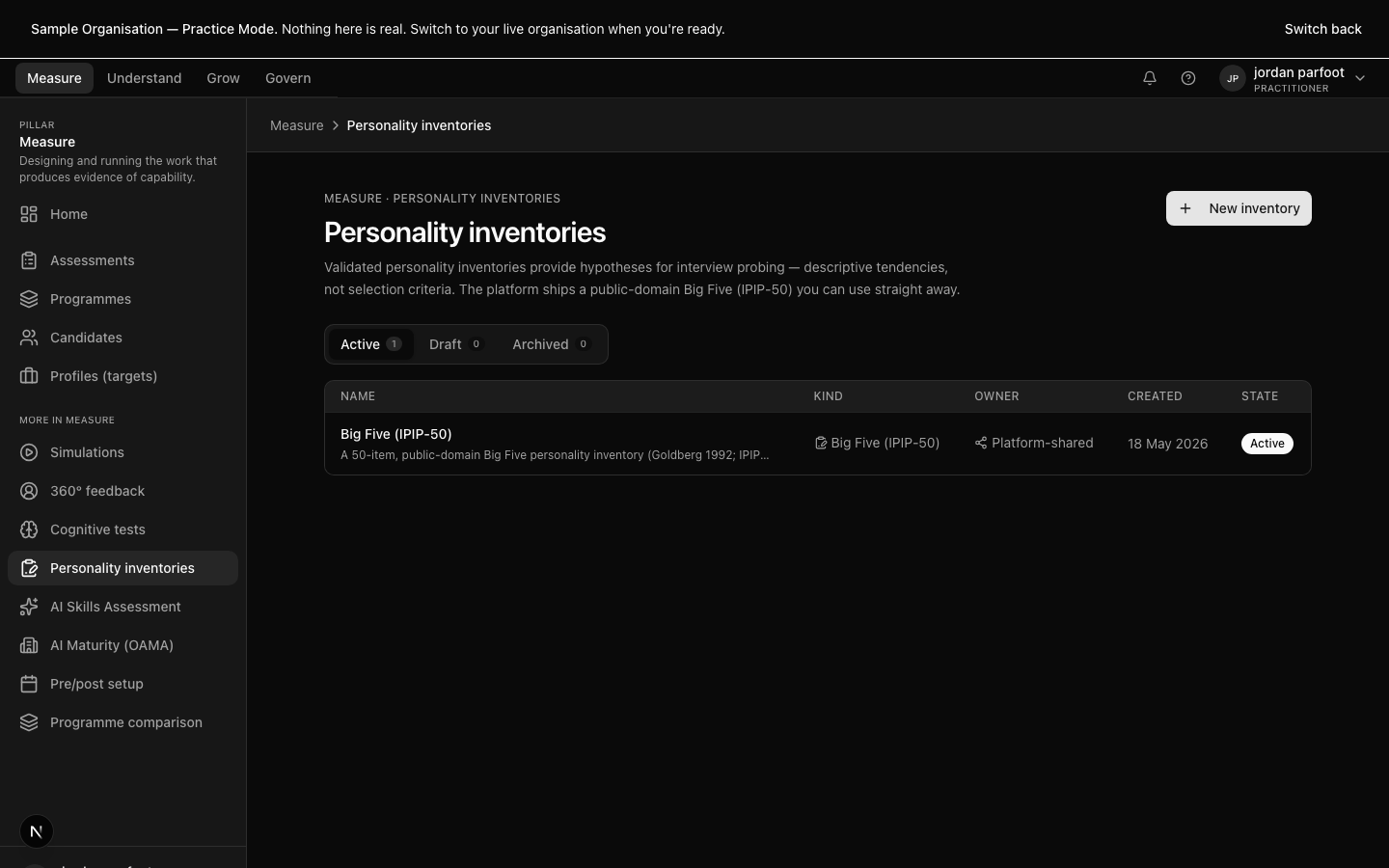
Personality inventory
IPIP-50 Big Five — descriptive tendencies that shape interview probing, never selection criteria.
360-degree feedback
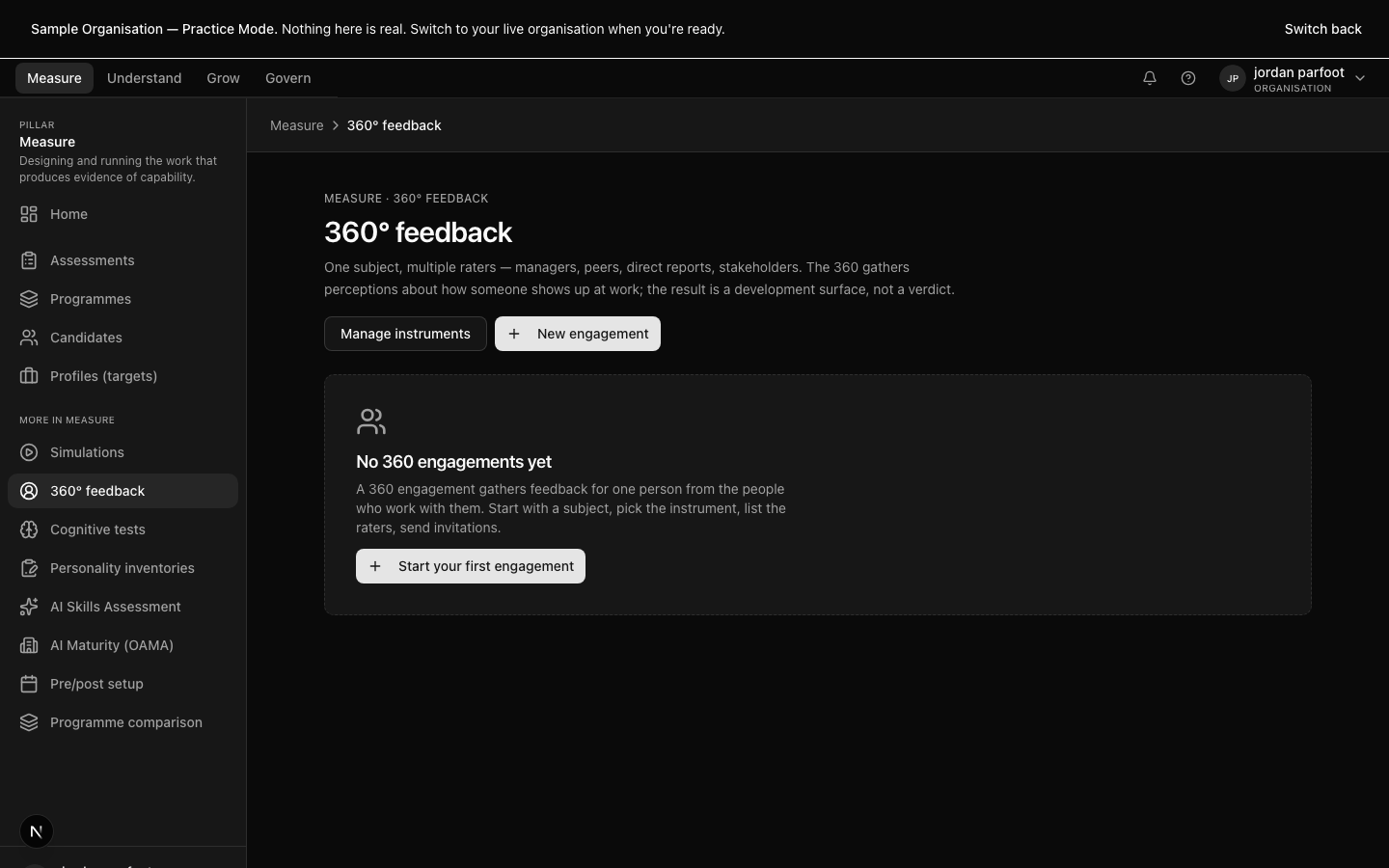
360-degree feedback
Multi-rater perspectives from managers, peers, direct reports, and stakeholders, with anonymity-preserving suppression thresholds.
AI Skills Assessment (AISA)
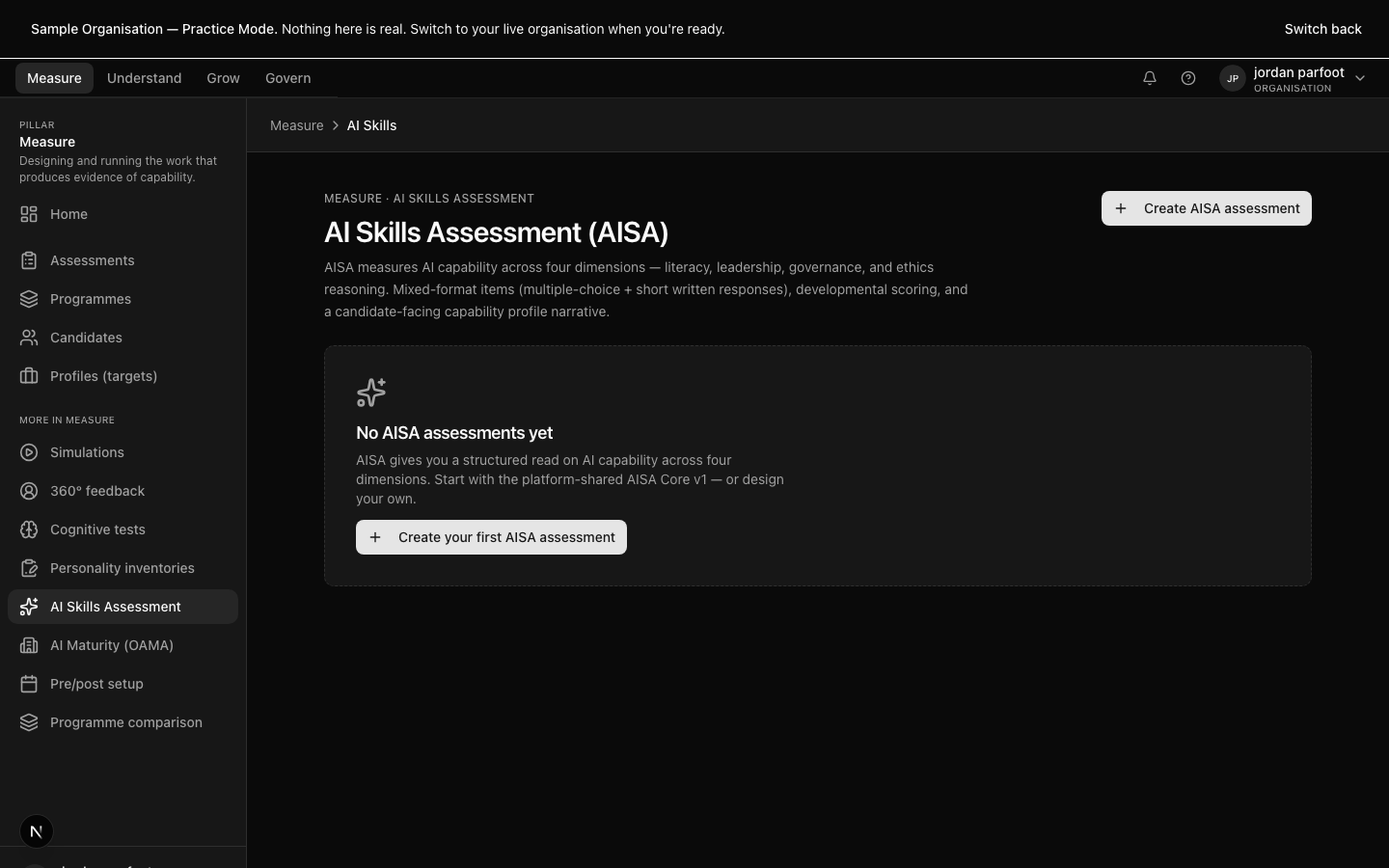
AI Skills Assessment (AISA)
AI capability across five themes — literacy, responsible use, applying AI, governance, and technical craft — levelled on the SFIA 1–7 responsibility scale with APS-classification equivalents. Run conversationally, async, structured, or by portfolio.
Organisational AI Maturity (OAMA)
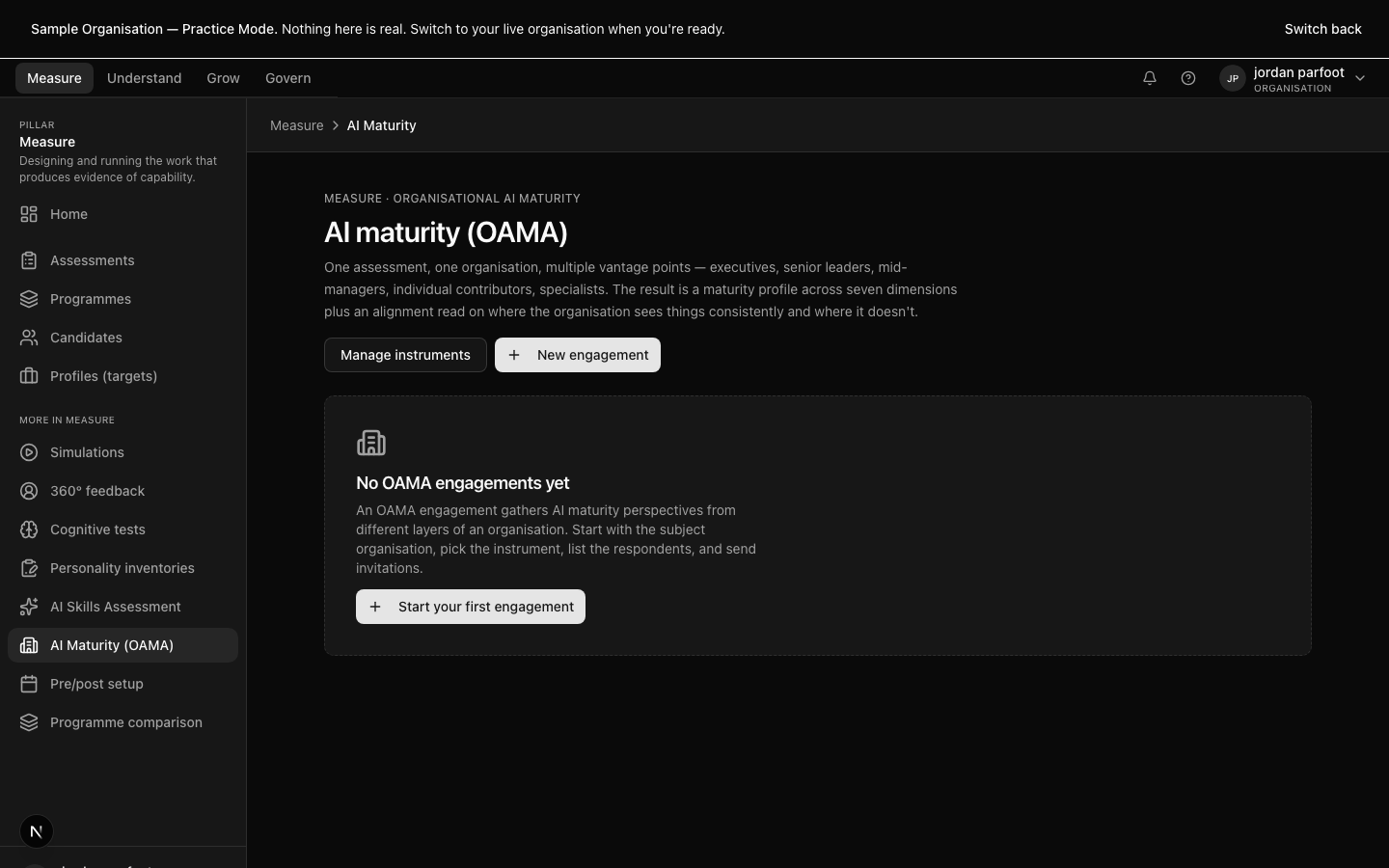
Organisational AI Maturity (OAMA)
Organisation-wide maturity across strategy, data, talent, governance, ethics, culture, and infrastructure — weighted across executive, leader, and on-the-floor views.
Pre/post measurement
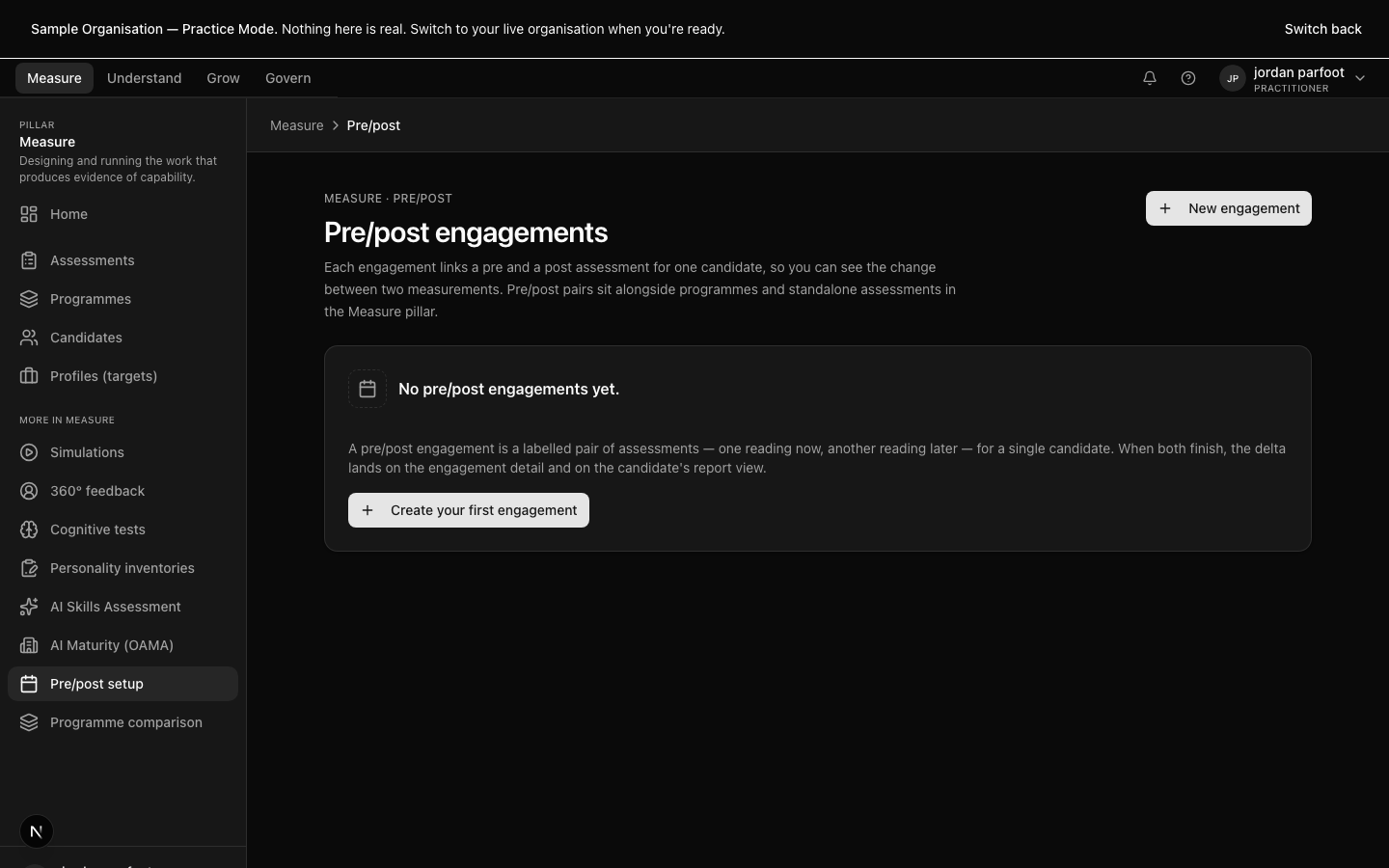
Pre/post measurement
A short baseline now, a re-measure later. The platform tracks the delta and rolls it into programme outcomes.
Workforce baseline
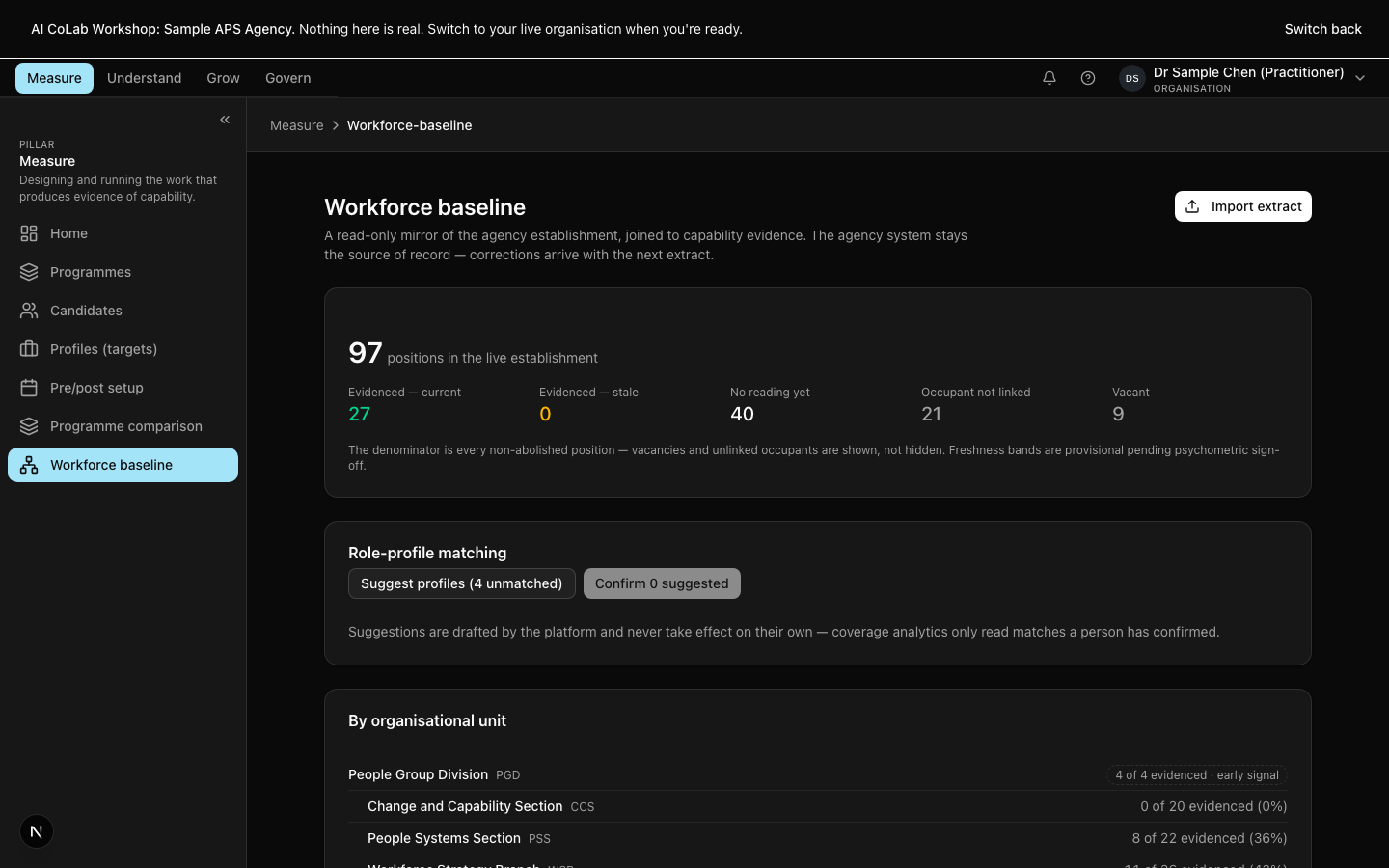
Workforce baseline
The organisation's capability census — what capability it actually holds, aggregated from signed ratings by skill, level, and unit, refreshed as evidence lands.
Turning evidence into shared meaning.
Read what came back, compare what different assessors saw, run calibration practice, look across a cohort. Understand stops at "what is true."
Reports
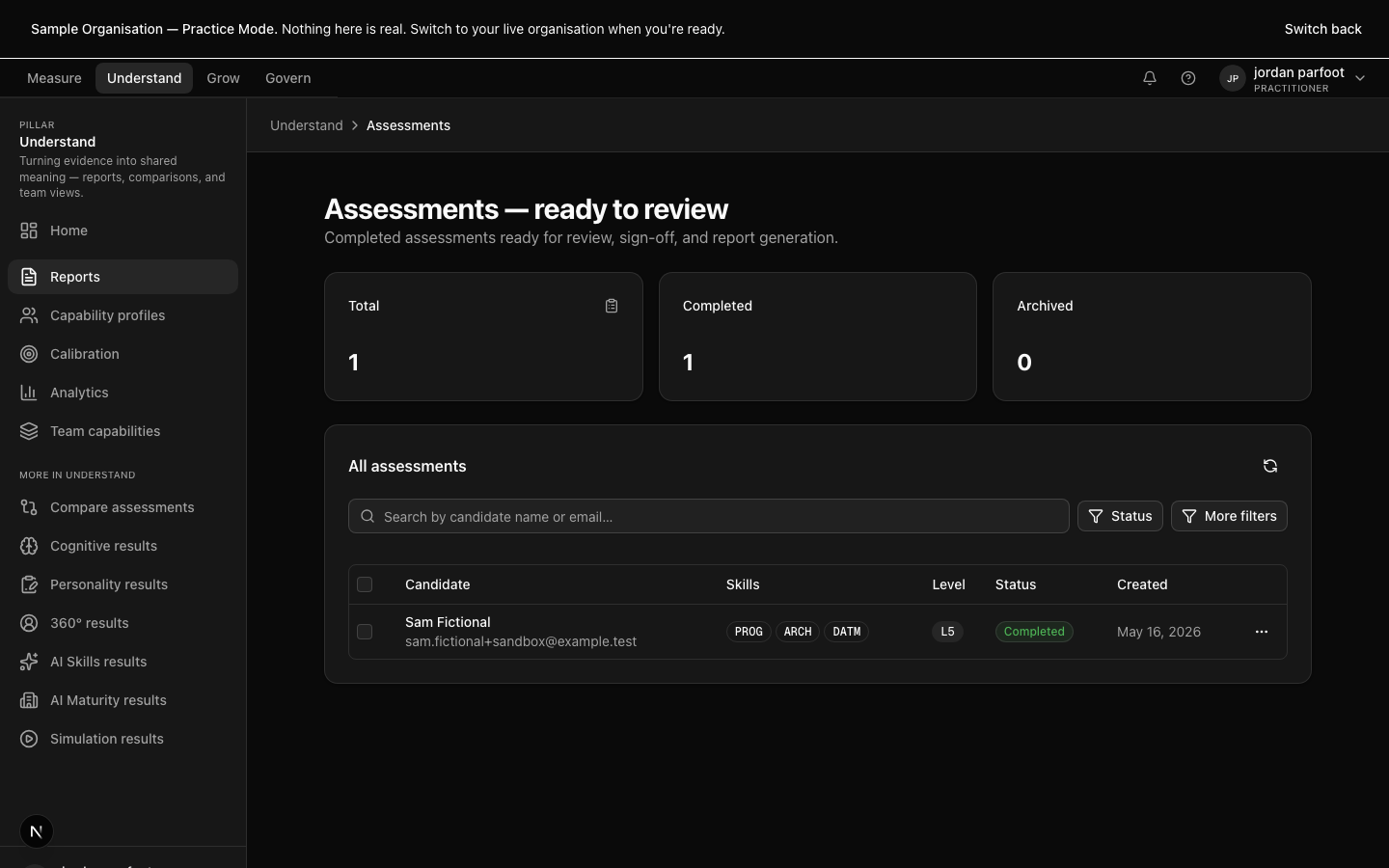
Reports
Strength-first reports with every rating linked to specific evidence. Practitioner, candidate, and signed-off variants share the same source.
Capability profiles
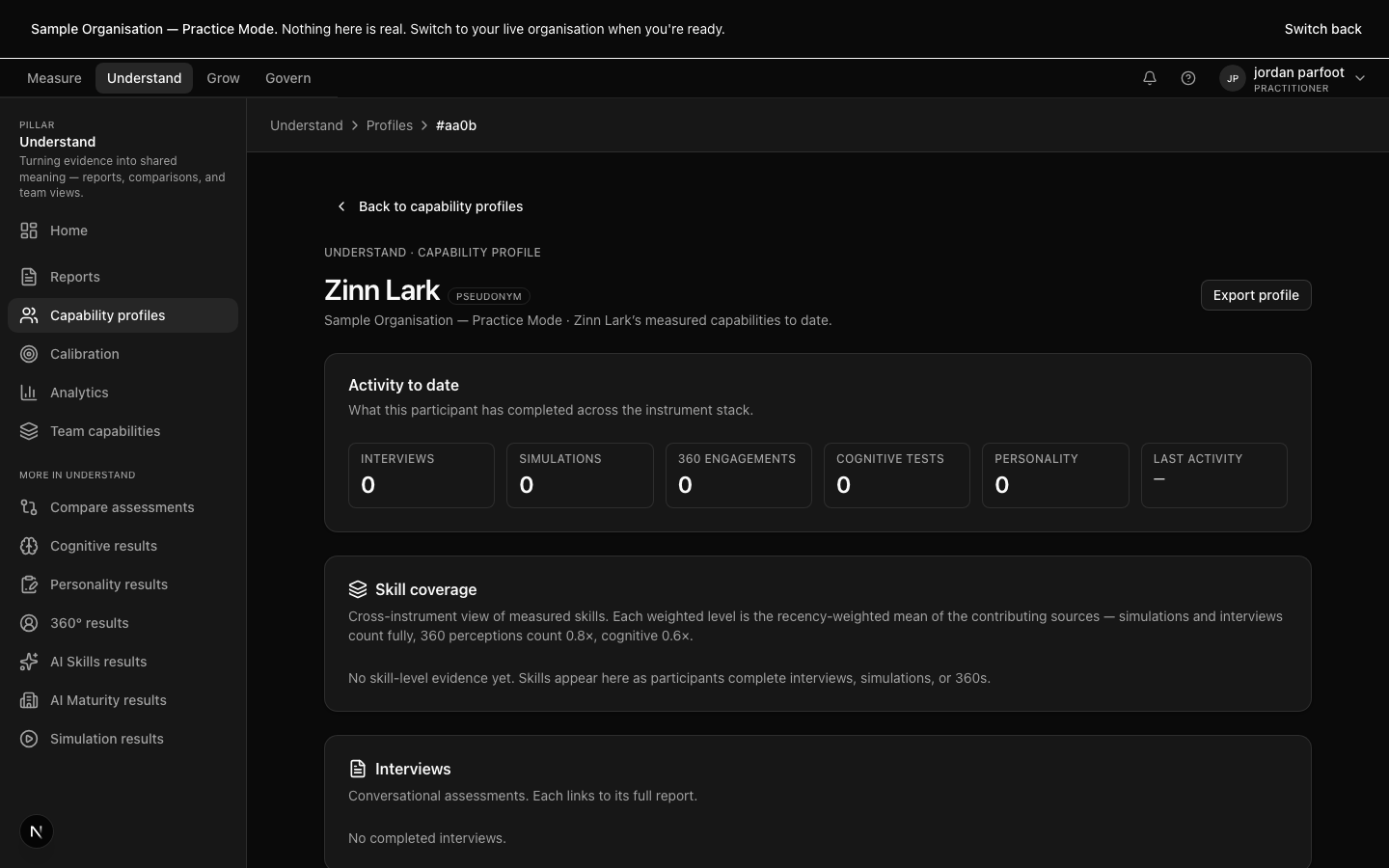
Capability profiles
Cross-instrument profile per participant — interview, simulation, 360, cognitive, and personality results triangulated in one view.
Compare assessments
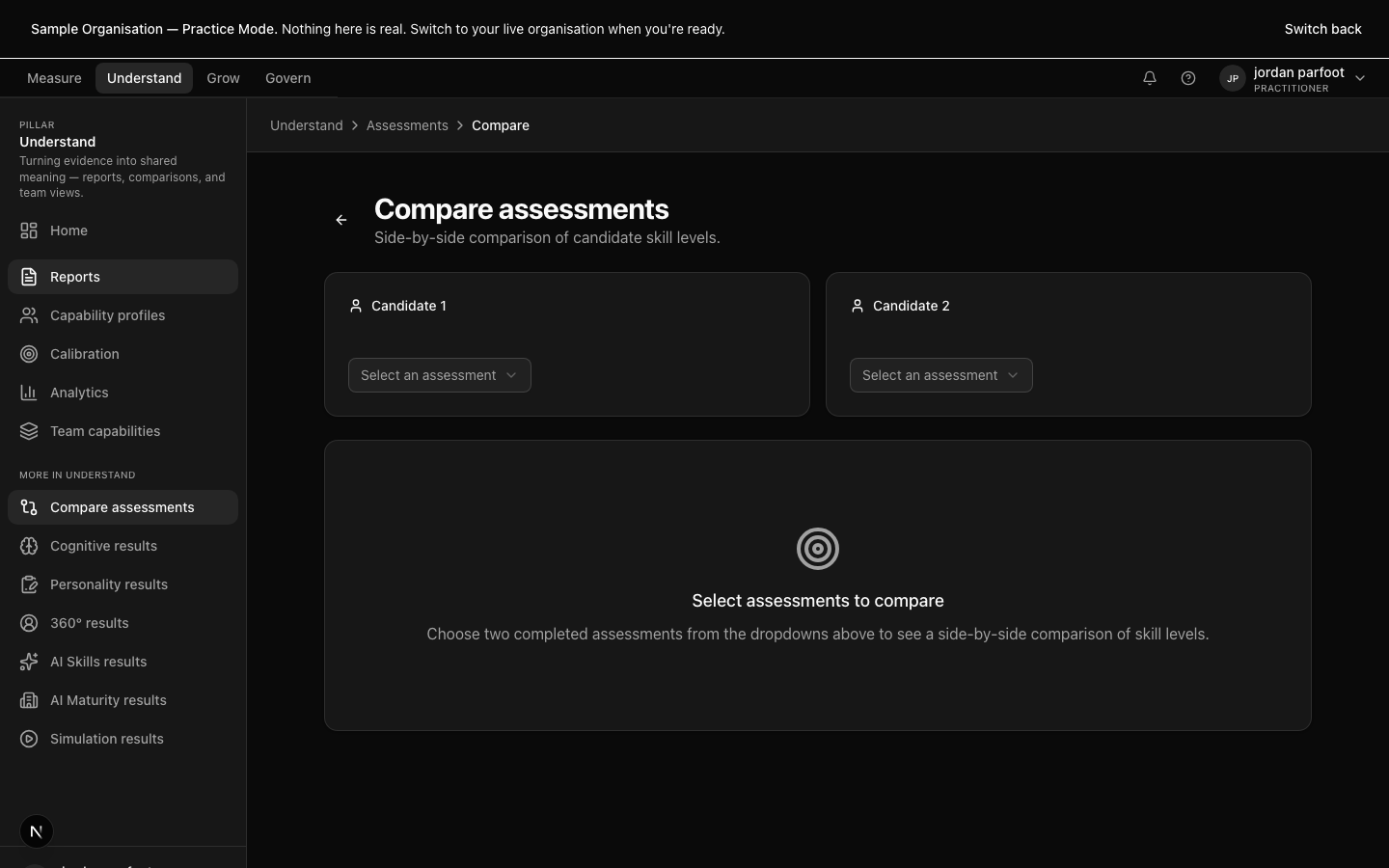
Compare assessments
Two finished assessments side-by-side. Rater drift is named, not hidden — the surface is built to make divergence legible.
Calibration practice
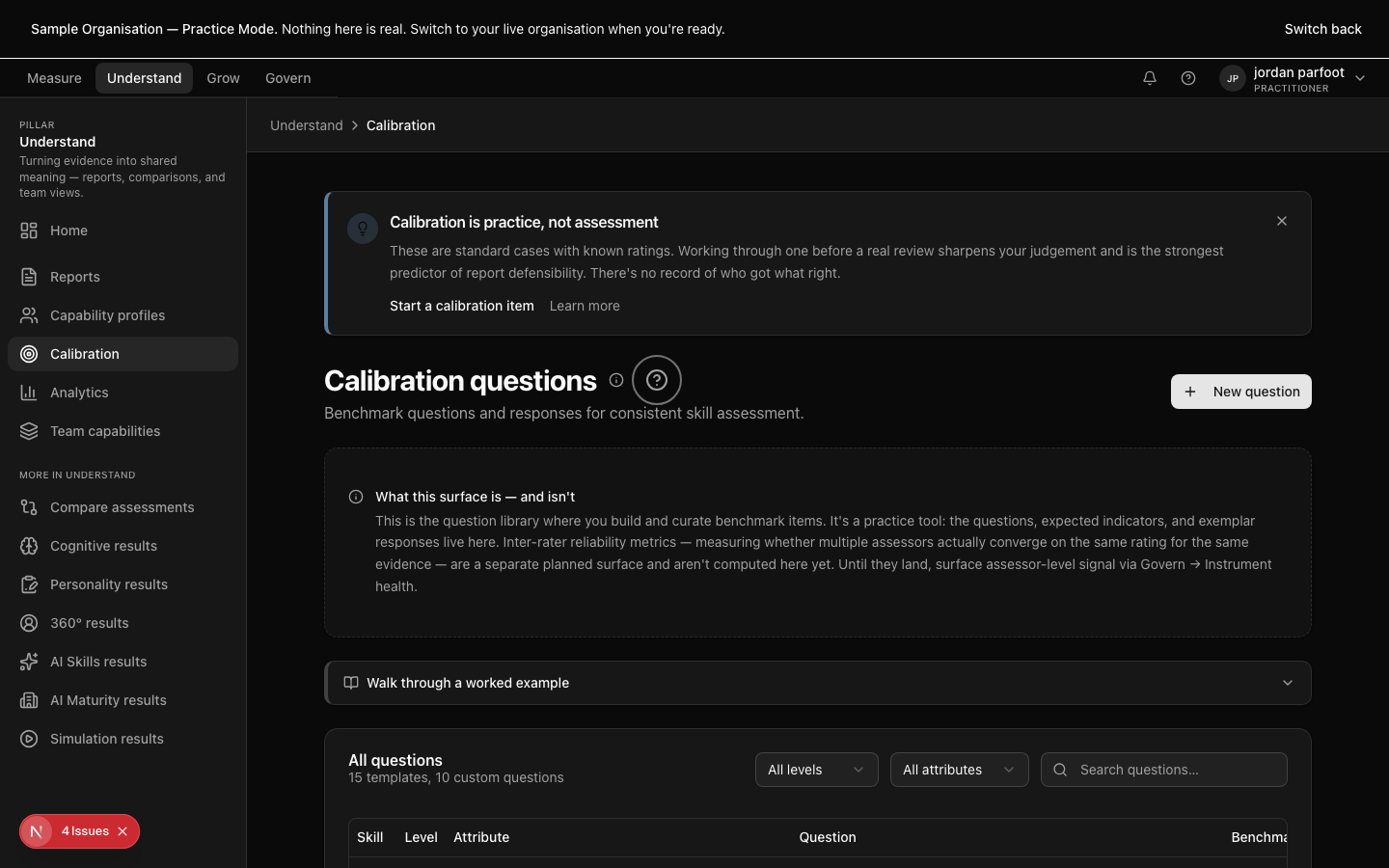
Calibration practice
Rate shared evidence against benchmark responses, surface dissent before it lands in real ratings, build your own accuracy.
Integration session

Integration session
The structured multi-assessor meeting that resolves dissent before sign-off — instruments sit side-by-side, evidence is named, the consensus is recorded.
Analytics
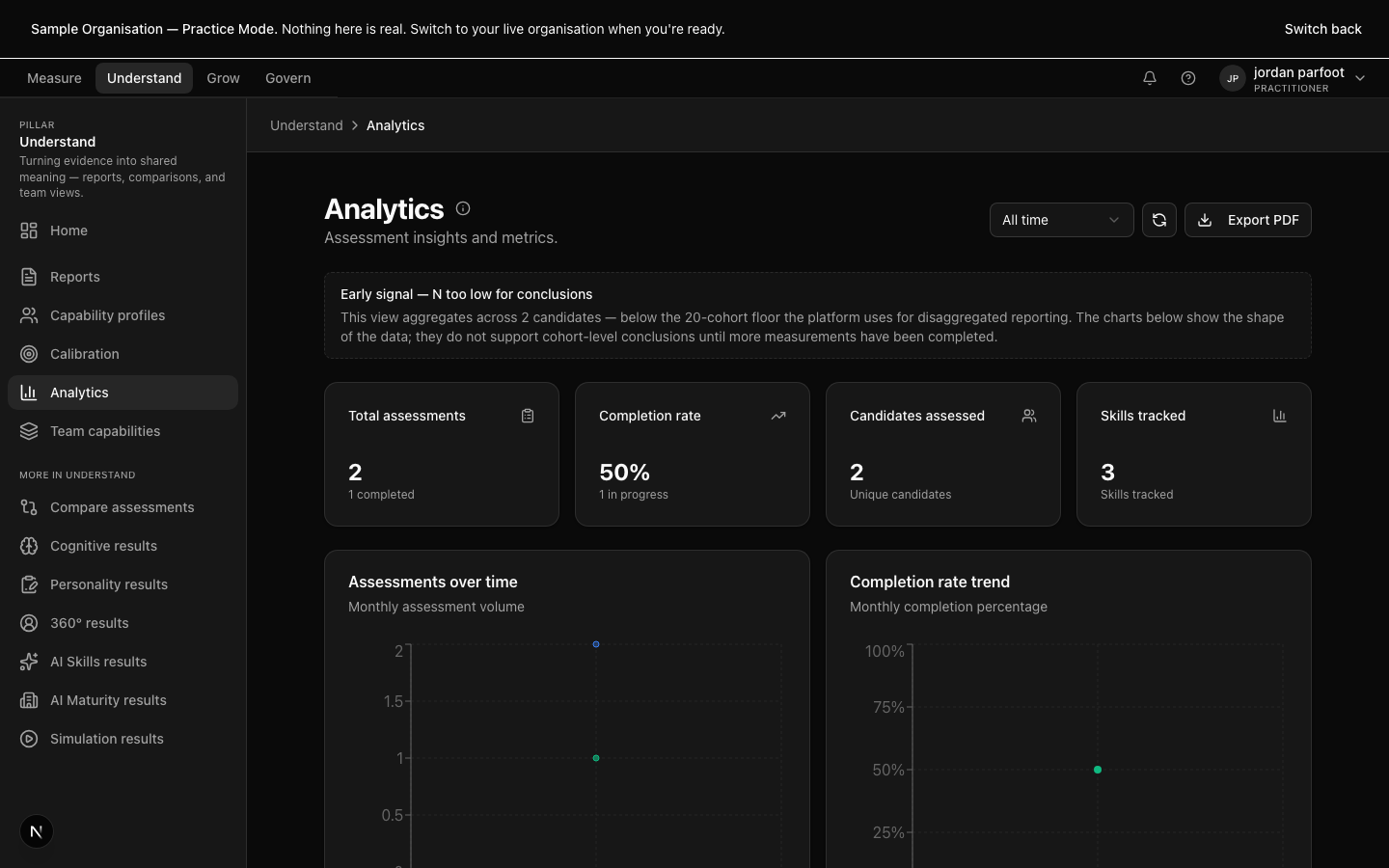
Analytics
Cohort drill-down, longitudinal deltas, benchmark ranges (research-anchored until consented cross-organisation data accrues), assessor performance, instrument coverage. Charts with date-range controls and a print-friendly export.
Team capabilities
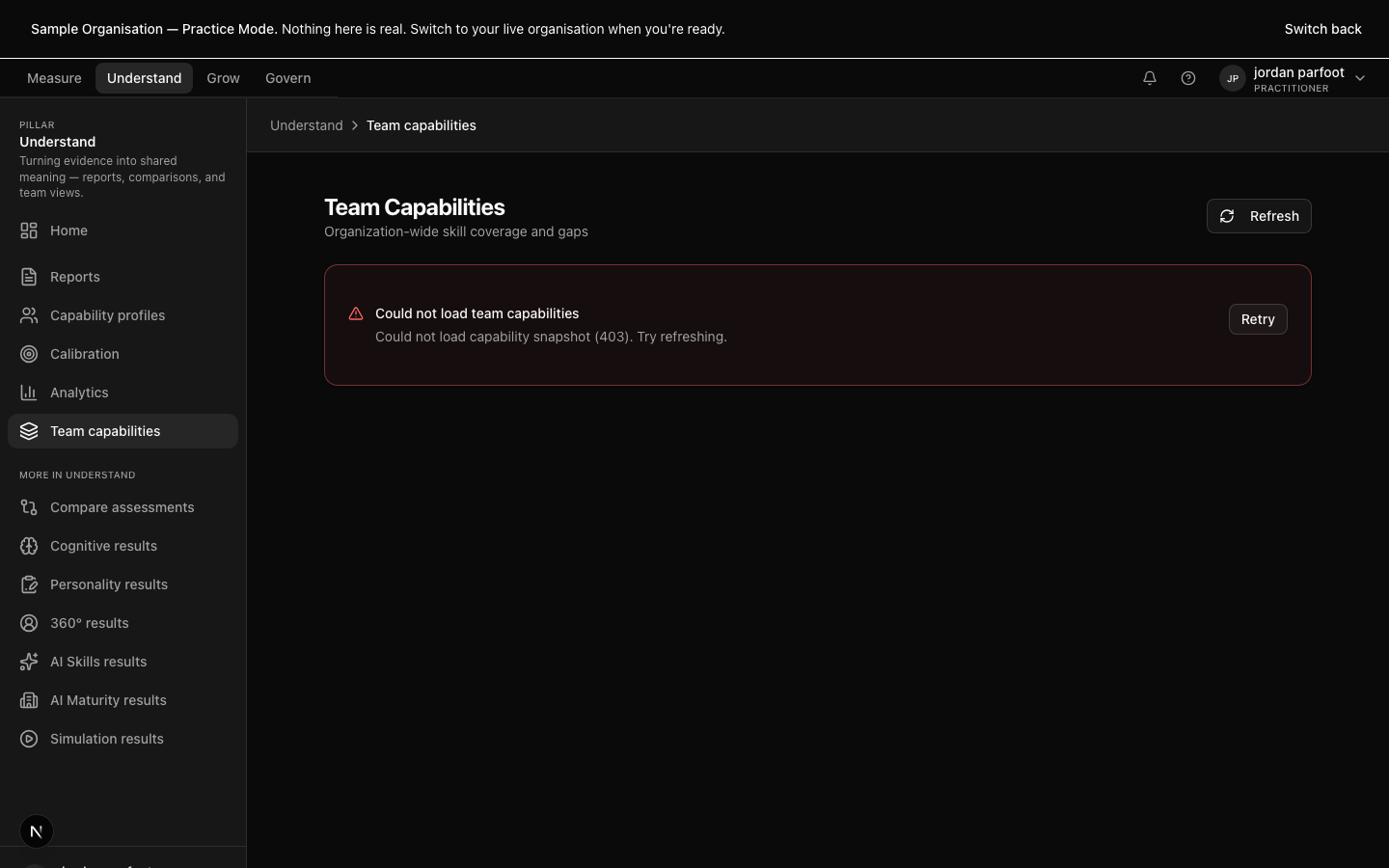
Team capabilities
Heatmaps and gap views across teams and roles, with consent-aware aggregation and drill-through to the individuals you can see.
Evidence search
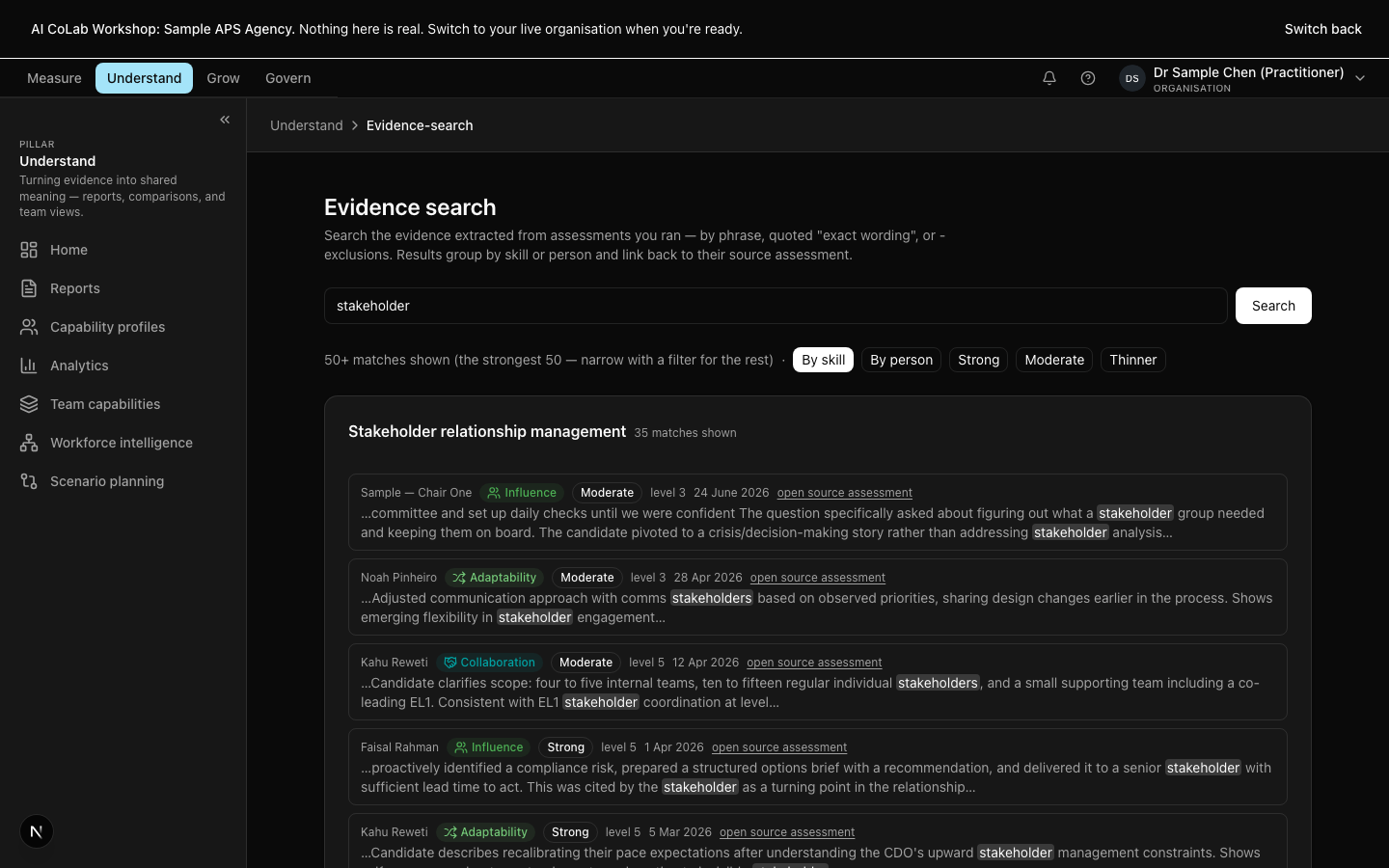
Evidence search
One query across every transcript passage and note you're accountable for — ranked, highlighted, grouped by person or skill, consent-aware throughout.
Workforce intelligence
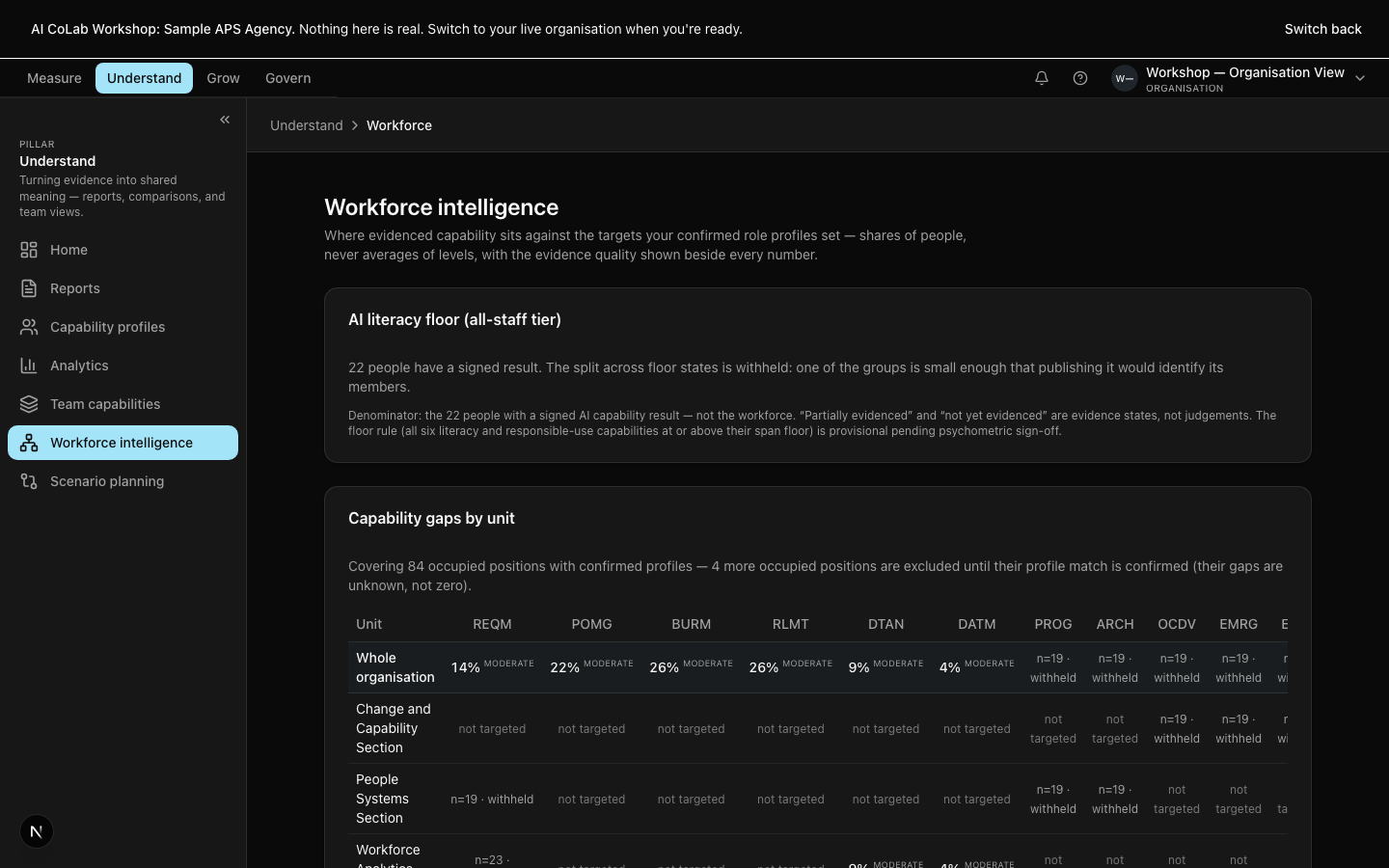
Workforce intelligence
Gap and floor views against role profiles at organisation level — aggregate first, honest about thin evidence, drill-down bounded by consent.
Scenario planning
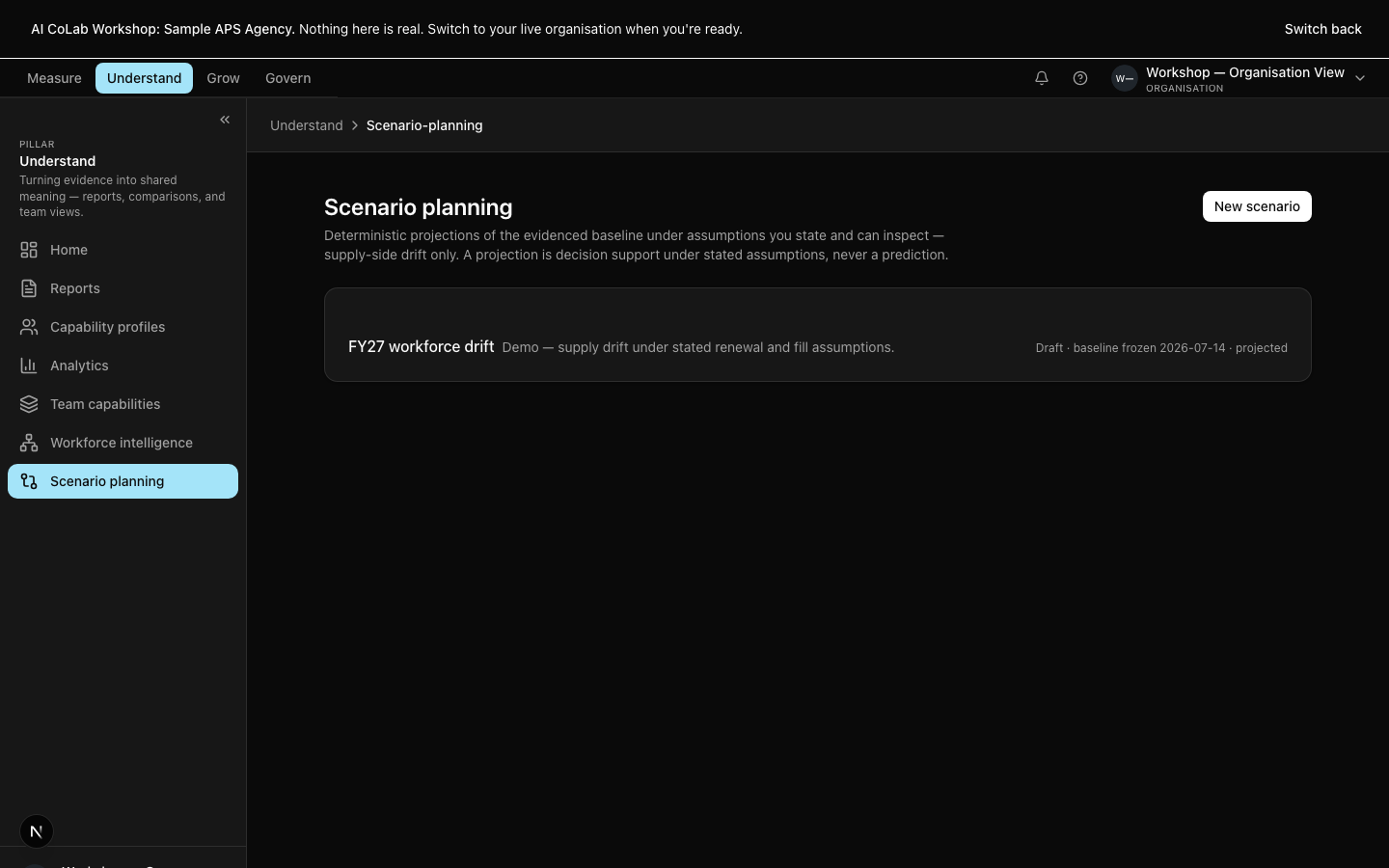
Scenario planning
Supply-drift projections over the workforce baseline — attrition, hiring, and development assumptions you set, with the assumptions named beside the outputs.
Turning understanding into deliberate change.
Development plans, goals, recommendations, longitudinal progress, and the Skills Passport — the participant's portable credential.
Development plans
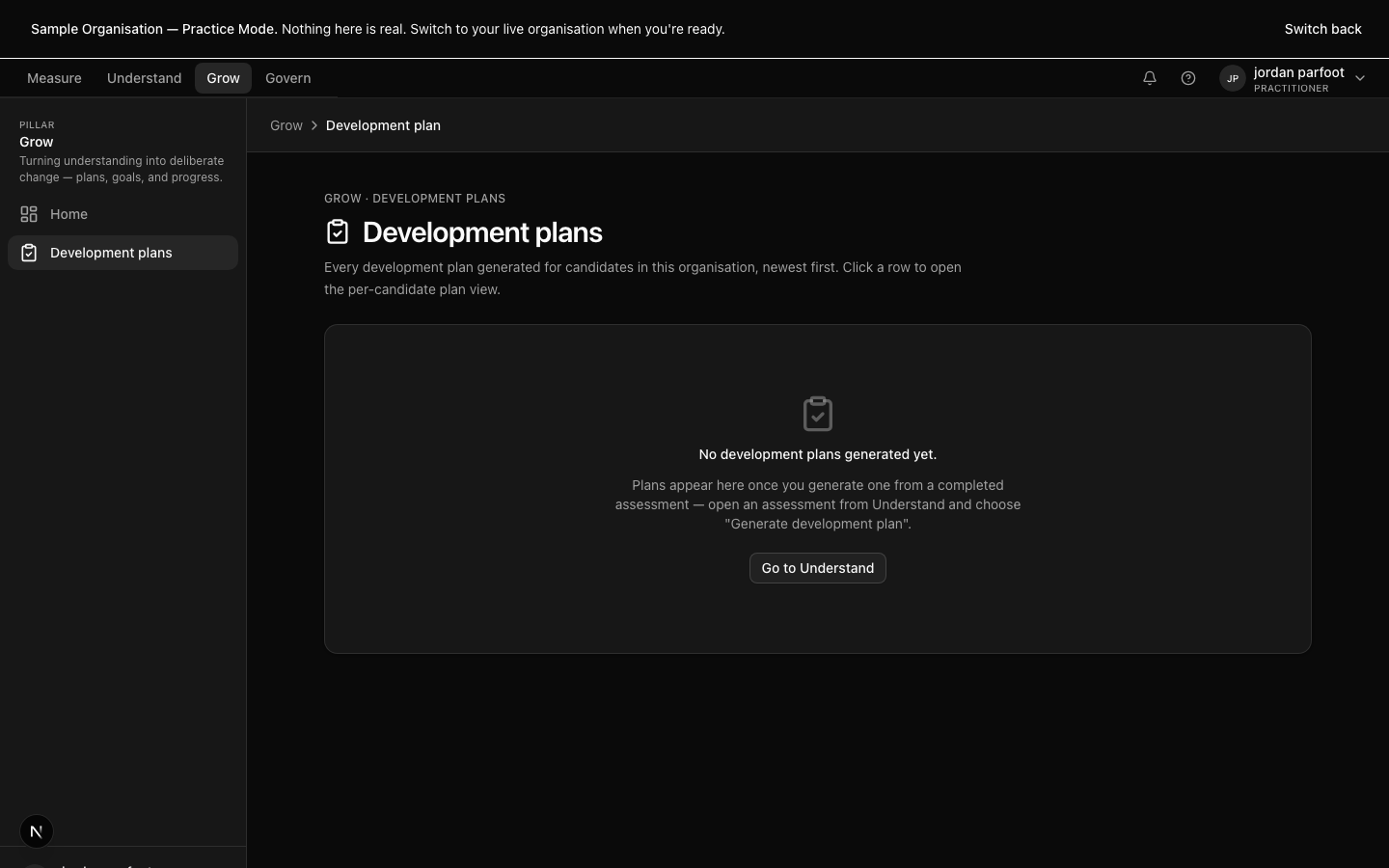
Development plans
A 70/20/10 structure anchored in evidence — on-the-job stretch, social learning, formal learning. Drafted from the report, owned by the participant.
My goals
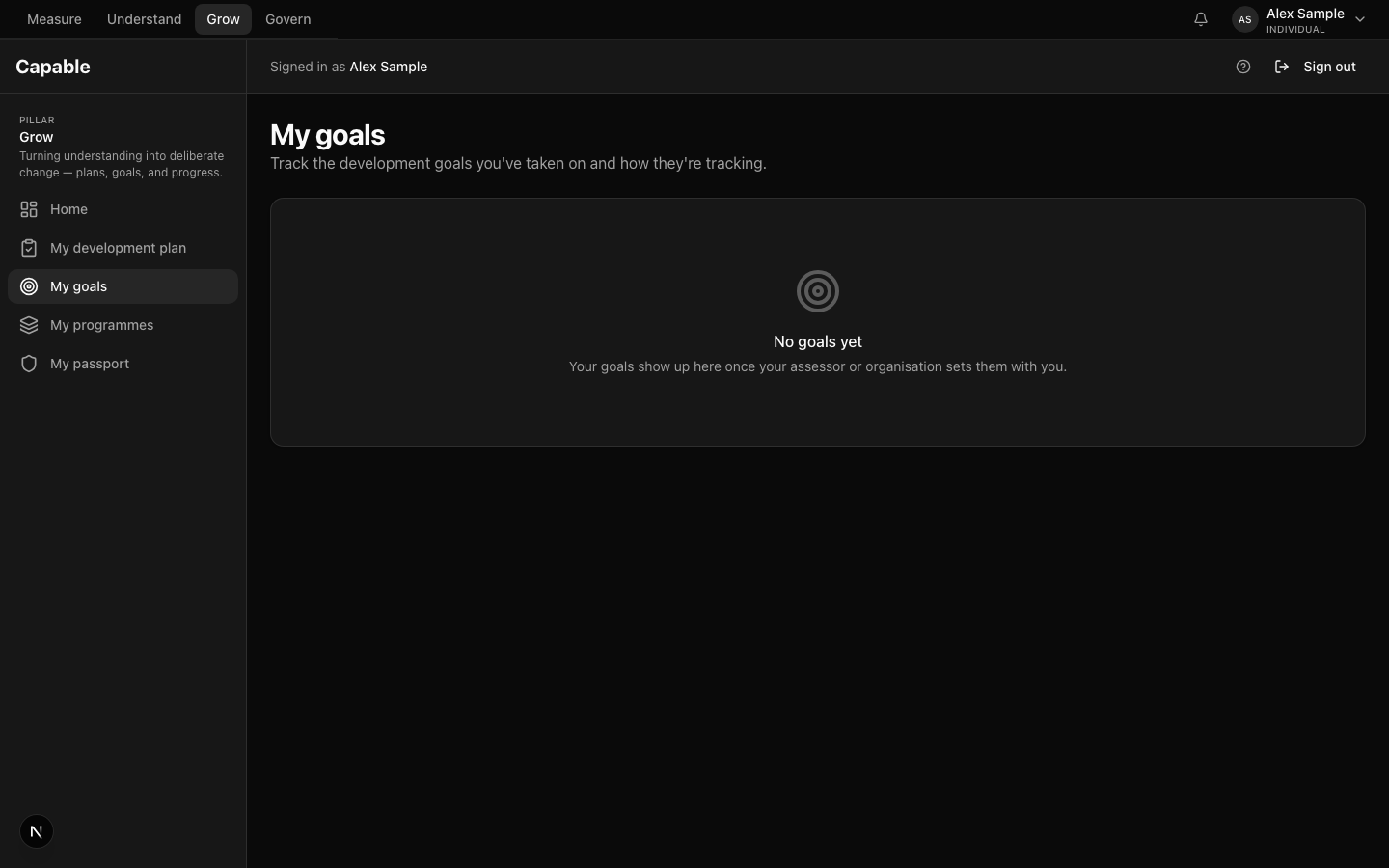
My goals
The participant-side view of the plan — the goals they've taken on, with progress notes and re-measurement points marked.
Recommendations

Recommendations
Learning resources matched to a skill and level — partner content, internal modules, reading. Attribution travels with each item.
Skills Passport
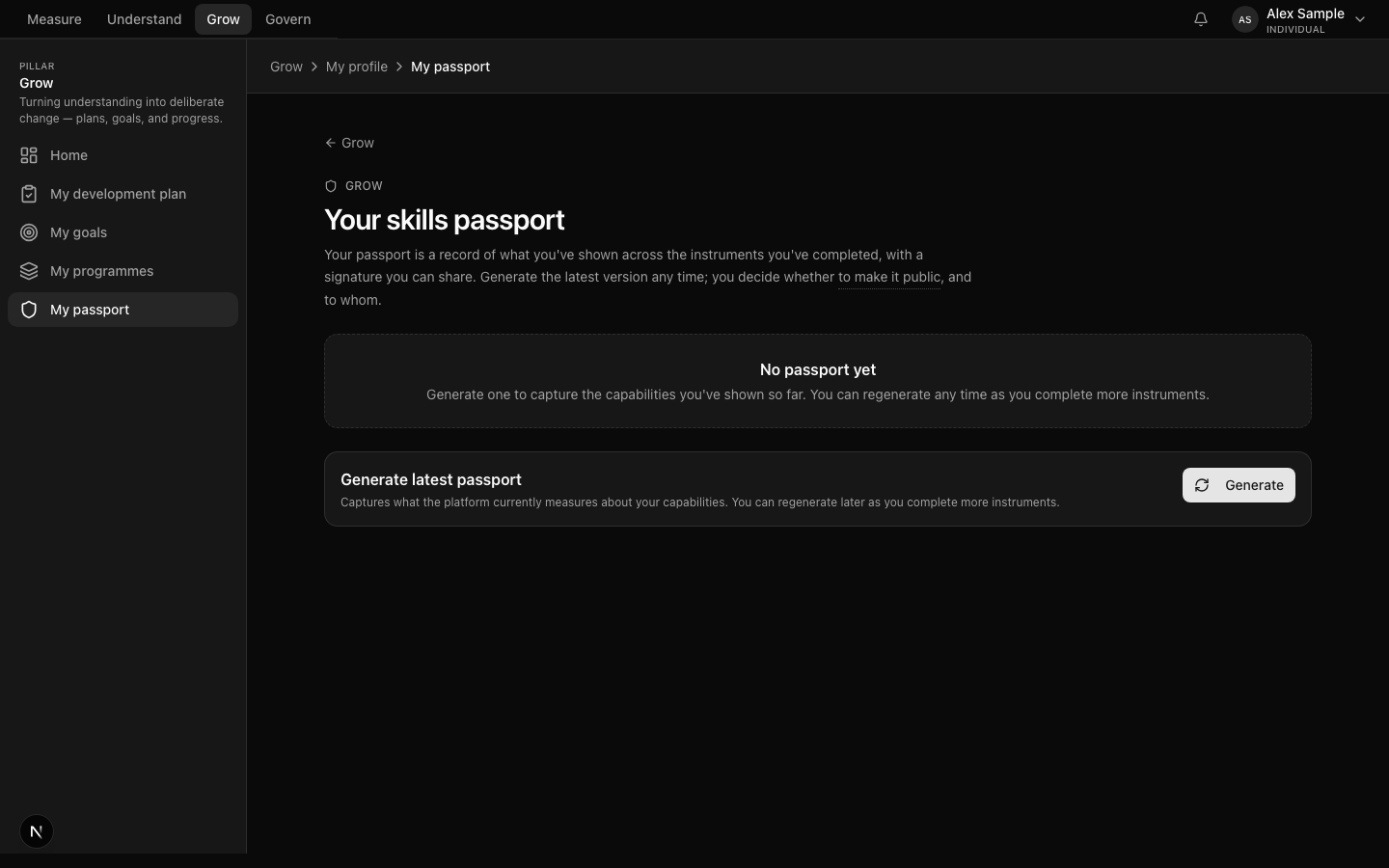
Skills Passport
A signed, portable record of what the participant has shown across the platform. HMAC signature, public verifier, candidate keeps the key.
Passport verification

Passport verification
The public verifier surface — receiving organisations confirm signature, framework translation (SFIA → ESCO or O*NET), and consent scope.
Longitudinal progress

Longitudinal progress
Movement against goals over time with re-measurement triggers visible — the proof that growth happened, not the promise of it.
Programme outcomes

Programme outcomes
Per-skill cohort movement between each programme's bookends — measured change, presented with the cohort size it rests on.
Internal mobility
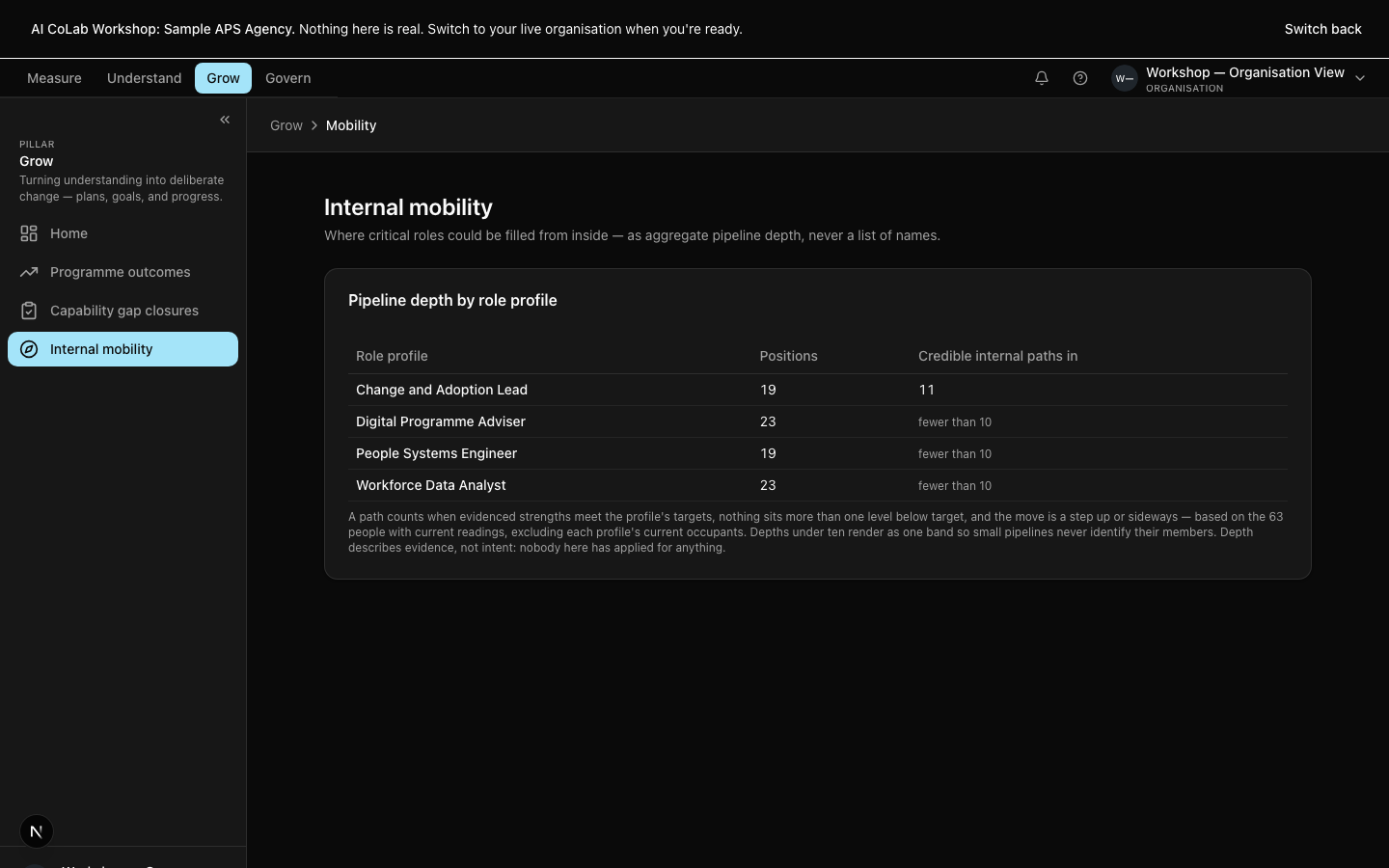
Internal mobility
Where critical roles could be filled from inside — pipeline depth per role profile, grounded in evidenced capability. Aggregate depth only, never a list of names.
Keeping the measurement credible and the data safe.
The policy envelope the other three pillars operate inside — sign-off, contests, fairness, defensibility, sector posture, audit, consent.
Notifications and queues

Notifications and queues
Sign-off, contest, correction, and reassessment queues with SLAs, reviewer routing, and a notifications inbox tied to each.
Contests, corrections, reassessment
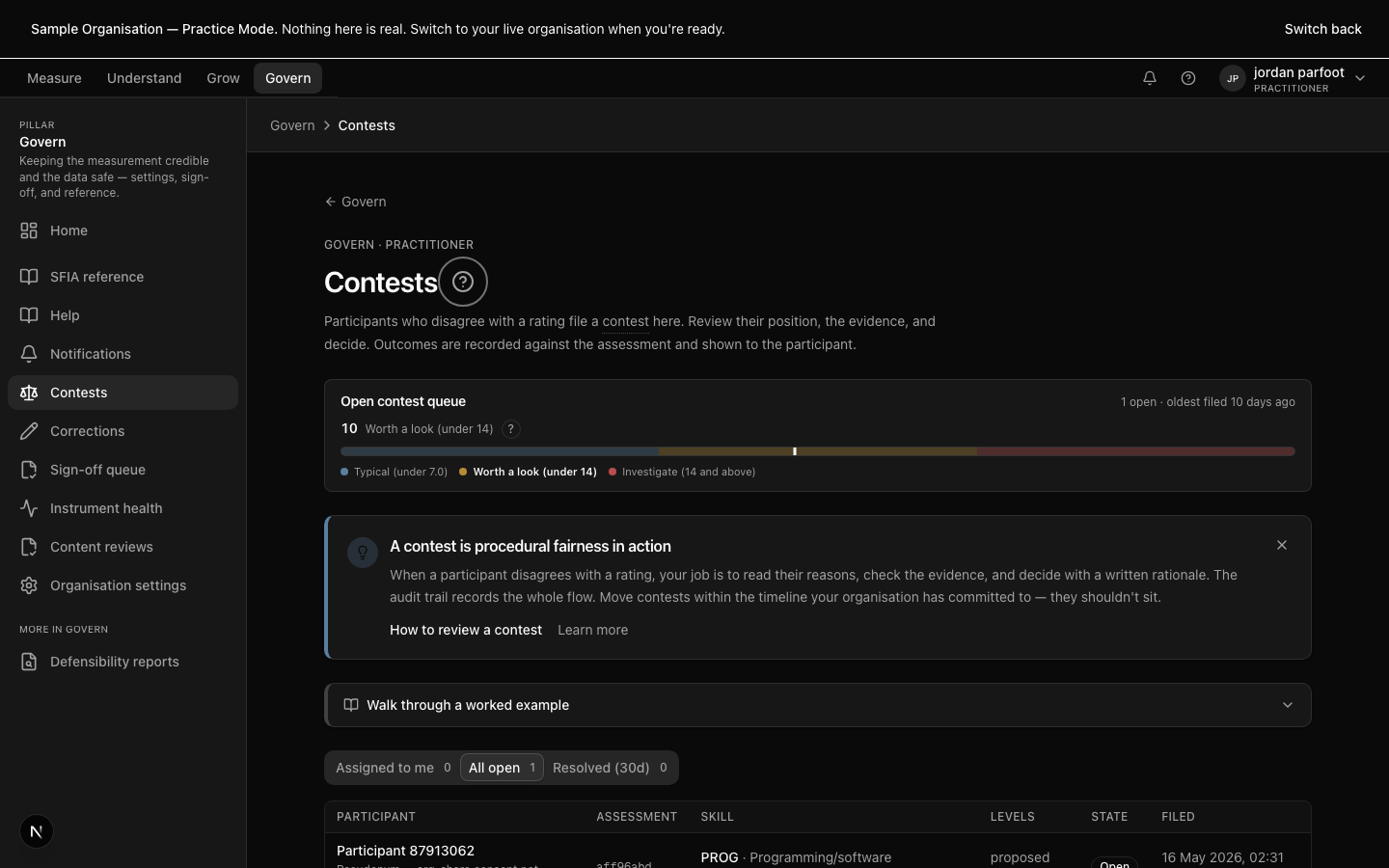
Contests, corrections, reassessment
Three named pathways for a participant to push back — disagreement with a rating, factual fix to the record, fresh measurement.
Fairness monitoring
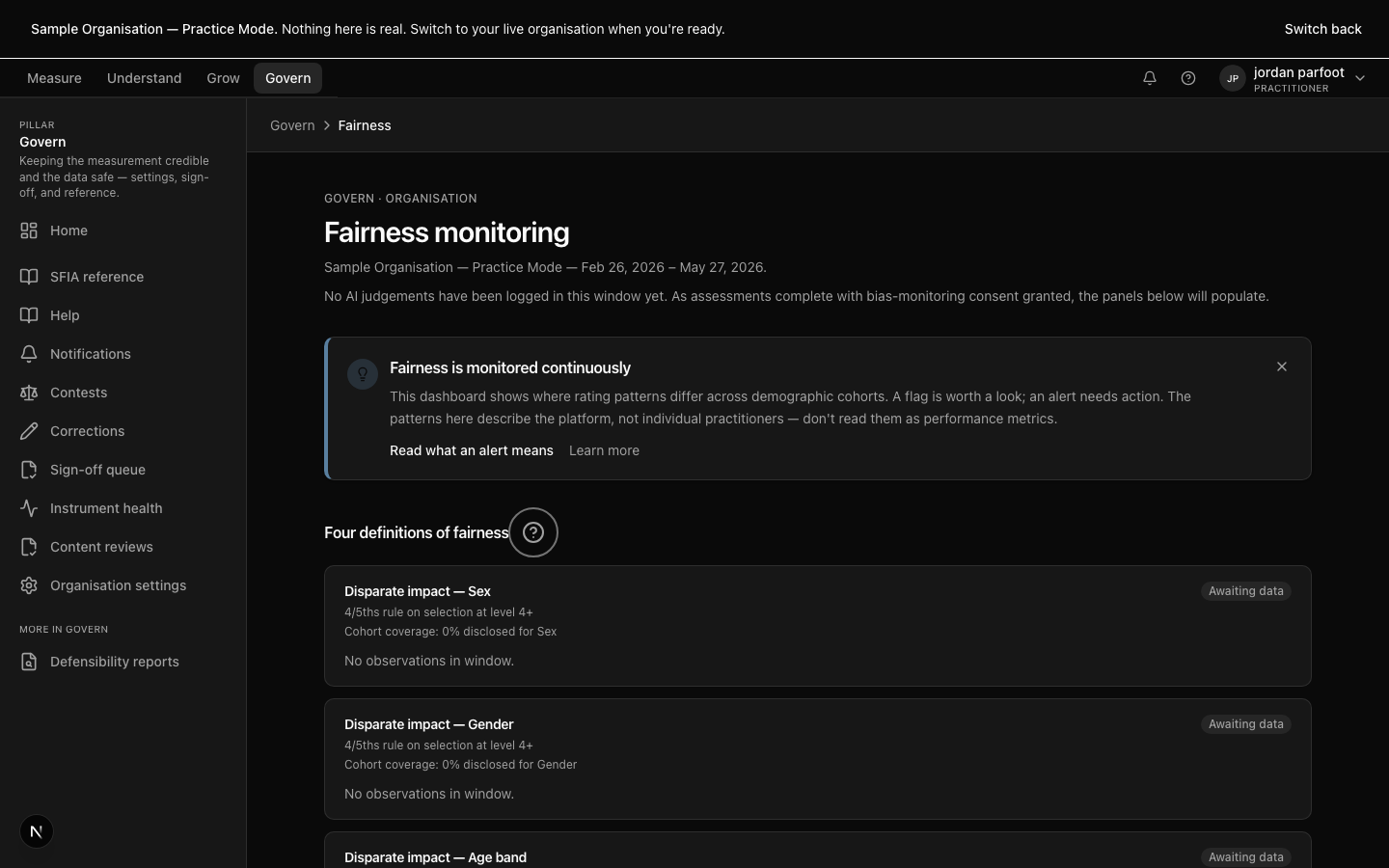
Fairness monitoring
Per-attribute disparate impact and counterfactual audit run live today; equalised odds and calibration join them as the outcome corpus accrues. Every metric is anchored to plain-language bands so it stays readable.
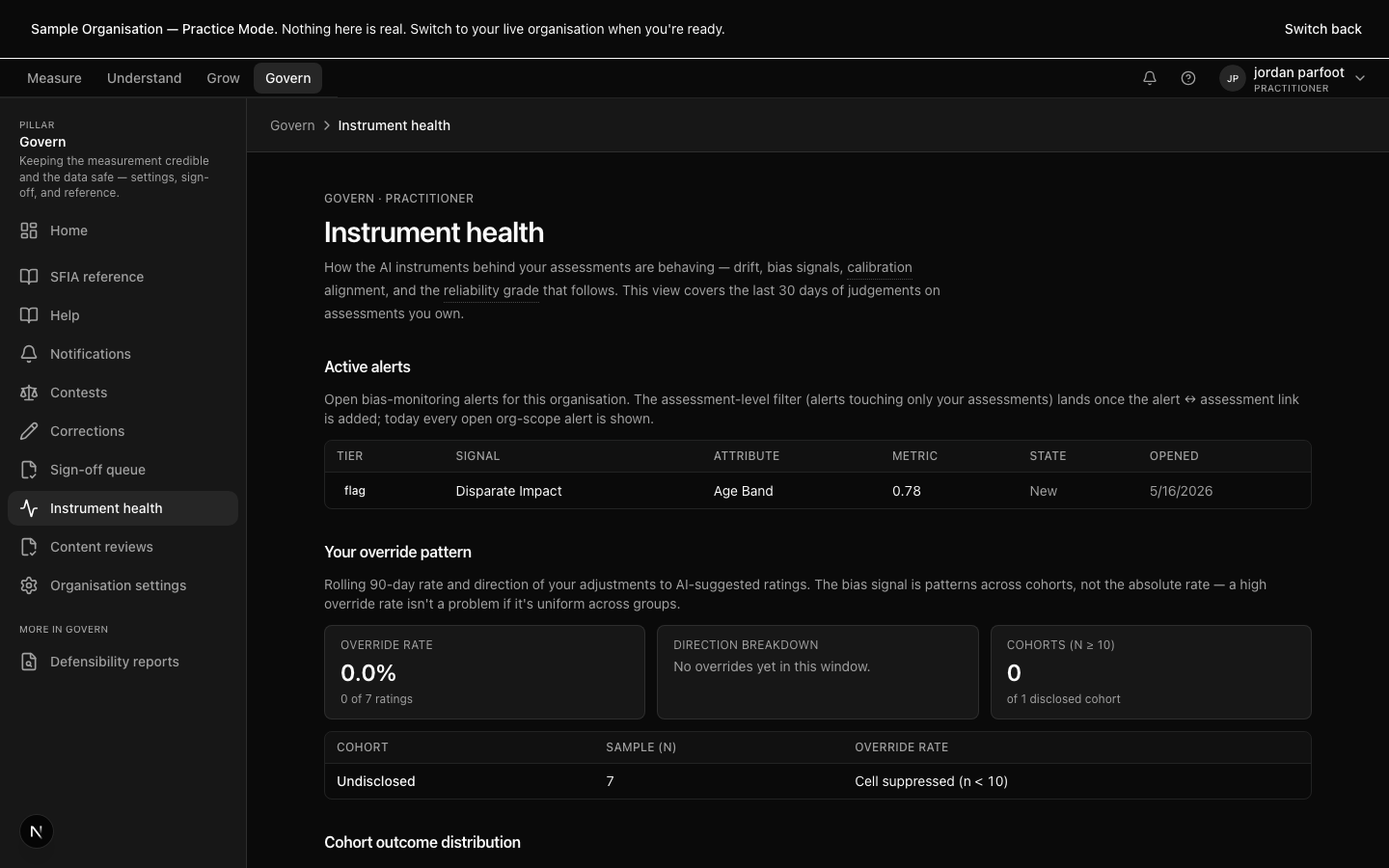
Instrument health
Instrument health
Drift, bias, and reliability indicators across every instrument in use. Surfaces the moment an instrument starts behaving differently from its norms.
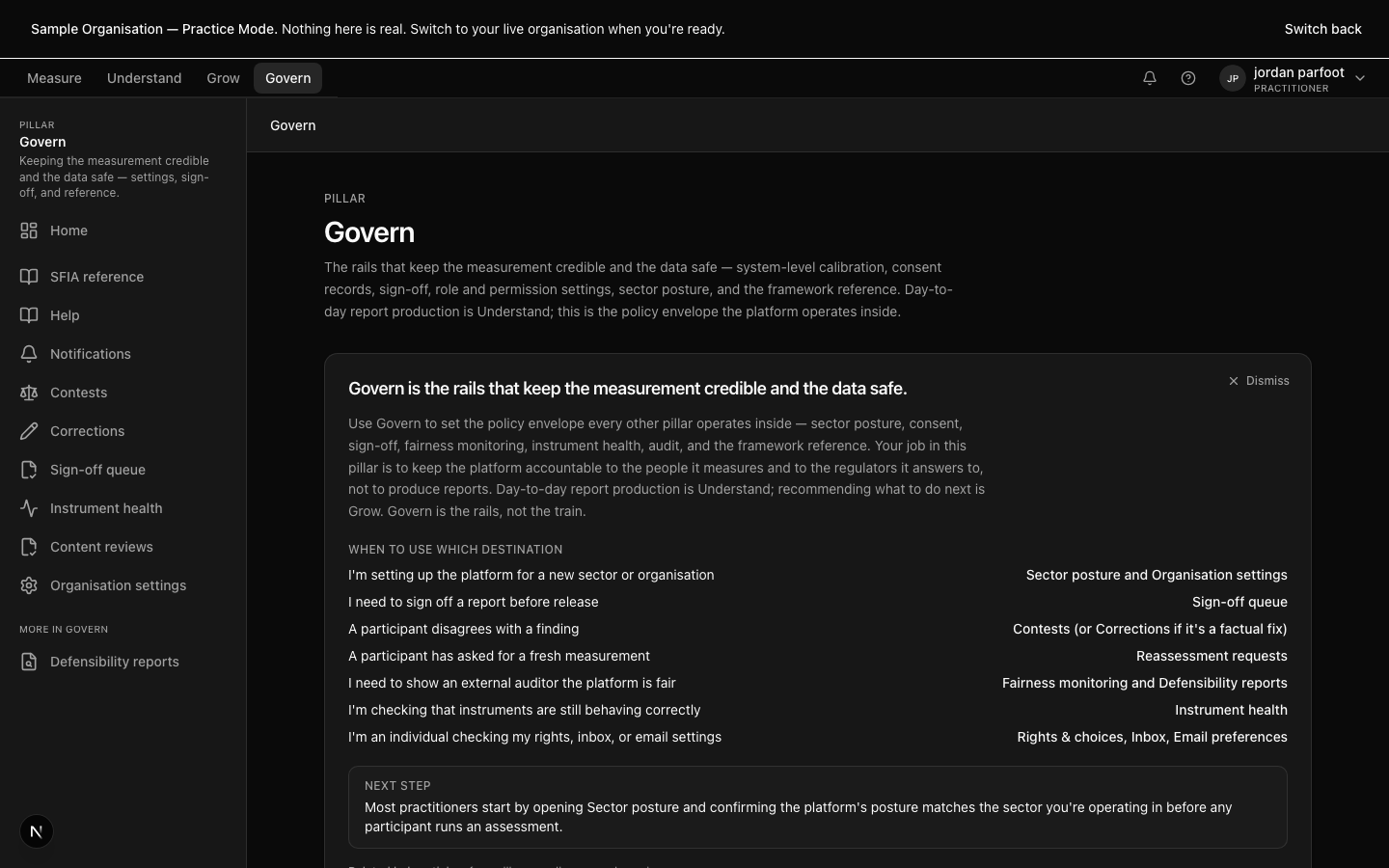
Sector posture
Sector posture
Seven sector packs flex tone, distress thresholds, consent shape, audit-ready posture, and example phrasings. One choice per deployment.
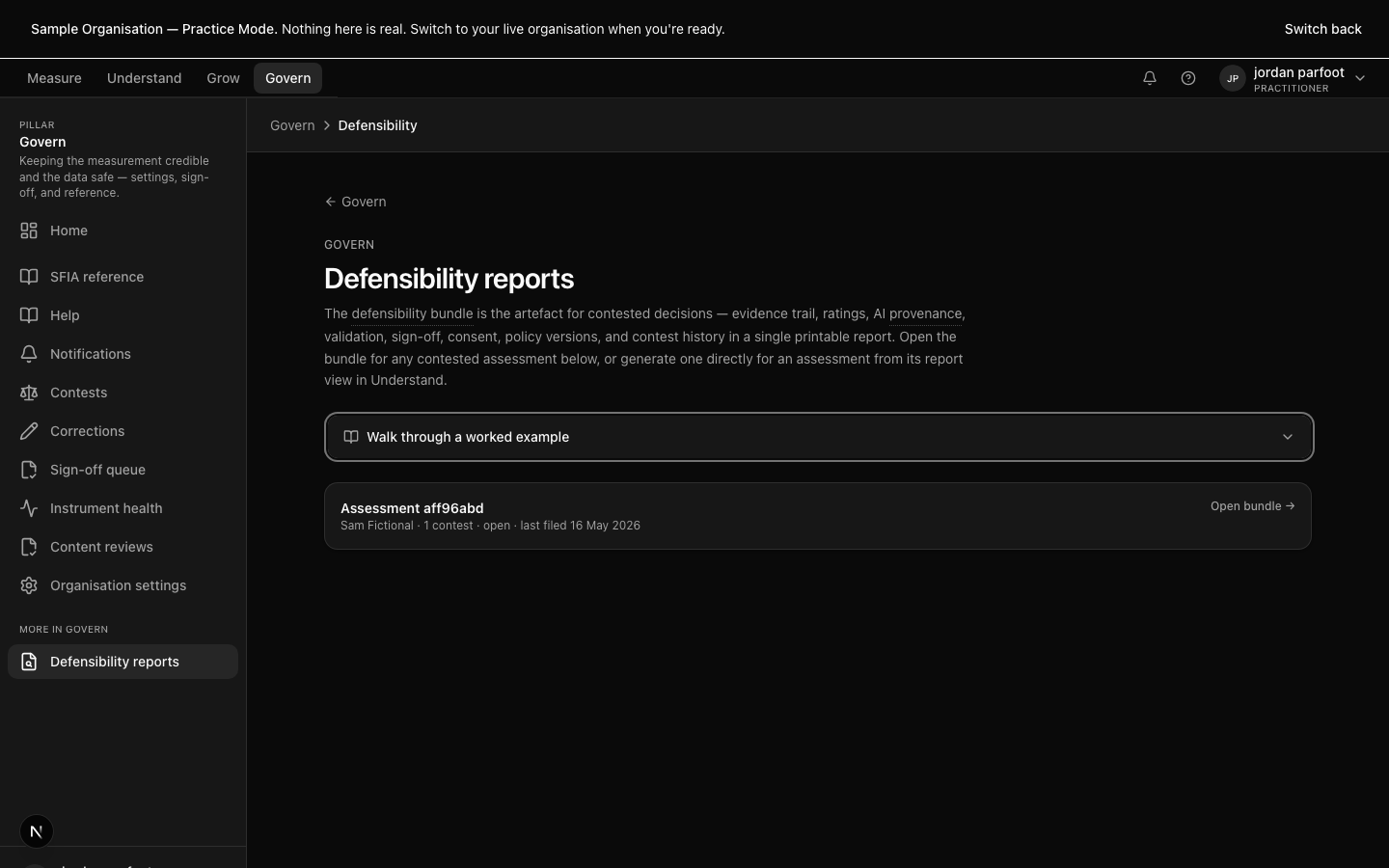
Defensibility bundles
Defensibility bundles
Two shapes — quarterly assurance for boards and auditors, plus case-specific bundles for tribunals or regulators asking about one decision.
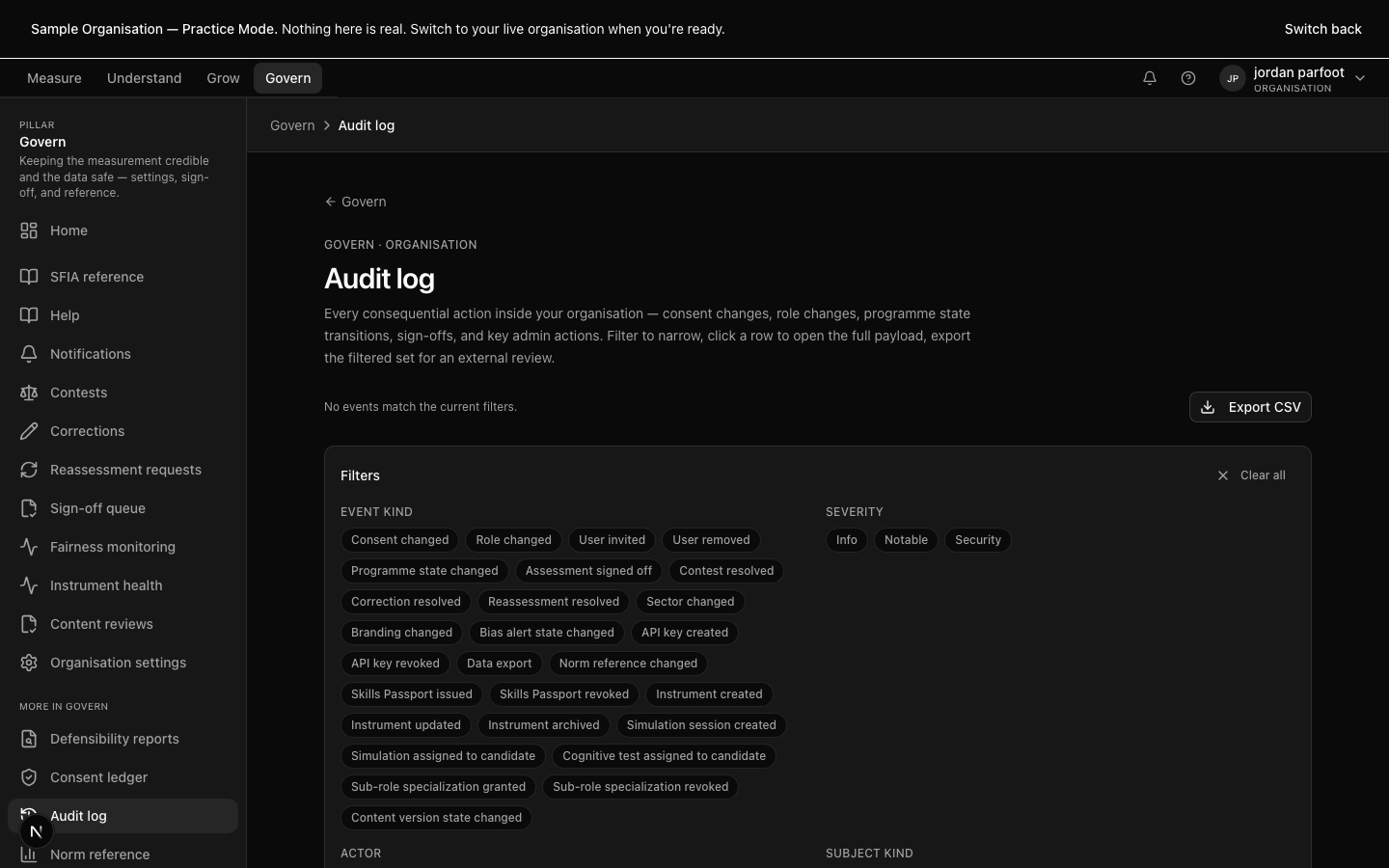
Audit log
Audit log
A hash-chain record of consequential actions — consent changes, role changes, programme transitions, sign-offs, key admin moves.
AI provenance ledger

AI provenance ledger
Coming soonEvery AI-derived artefact has a row — the input, the model family, the surface that produced it, the surface that consumed it.
Counterfactual audit

Counterfactual audit
Re-run an evidence bundle with a single attribute changed; surface the cases where the rating moves. Runs inside fairness monitoring on a routine cadence.
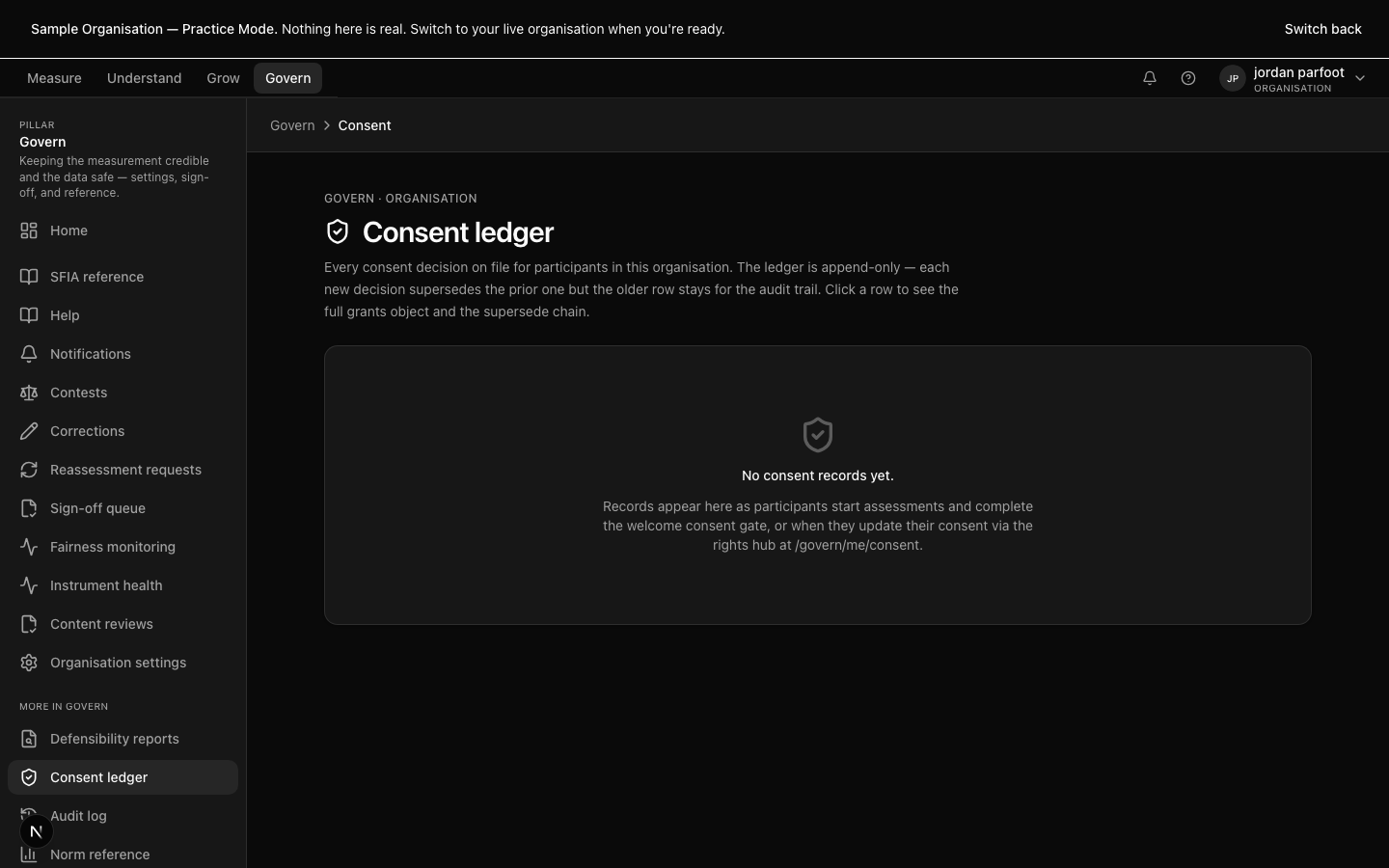
Consent ledger
Consent ledger
Every consent grant — interview tokens, magic-link grants, retention scope — in one auditable place, with revocation visible.
The capabilities that span the platform.
Surfaces that aren't owned by one pillar — they hold the four together.
Programme orchestration
Combine any instruments in any order around one person or one cohort. Six sector-keyed templates ship in the gallery; you can author your own.
Skills Passport
Portable credential the participant owns and shares. Signed, verifiable, translatable across SFIA, ESCO, and O*NET.
Capability profiles
One cross-instrument view per participant. Interview, simulation, 360, cognitive, and personality findings sit alongside each other.
Calibration practice
Every practitioner gets a calibration set seeded with their sector. Practice rating shared evidence; surface dissent before it hits production.
Sandbox practice
Every practitioner organisation arrives with a fictional sample organisation — invite a fictional participant, draft a report, sign off, respond to an appeal, all without touching real data.
Sector overlays
Seven sector packs flex tone, palette, distress thresholds, consent shape, and audit posture — government, corporate, community, healthcare, education, finance, plus an Indigenous-led variant.
Multi-locale
Five locales today — en-AU, en-GB, en-US, zh-CN, vi-VN — with the help centre authored in MDX so non-engineers can translate per locale.
By audience
Pillar-page coverage is the day-to-day reference for each audience. Each audience also has a dedicated page covering what they do, what they see, and how the platform meets them.
Talk to us
Tell us about the people you're measuring and the questions you need to answer. We'll show you the surfaces that match.