Trust posture

How Capable treats high-stakes capability decisions.

Eight commitments that shape every surface, every assessment, every decision.

These commitments are described here in summary; the full design strategy is public.

The eight commitments

The doctrine the platform is built on. Every surface is checked against these eight; a feature that violates one is redesigned before it ships.

Don't bury the safety nets

Crisis referral, the right to contest, and the audit trail are reachable from every surface where they are relevant. They are not stuffed behind menus, behind "learn more" links, or behind a profile area a participant has to find.

Every participant first-run carries a one-line note on how to pause, step away, or get help. Every practitioner orientation surfaces the contest, correction, and reassessment queues by name, one click away.

Pause before the consequential action, not after it

Consent, first interview, report generation, contest submission, and the rollout of model interventions all show a one-line frame of what happens next, before the action runs. The pause is for the user, not a celebration for the platform.

There are no progress-pressure indicators, no "let's go" framing on consequential confirms, and no design pattern that hurries someone toward a decision they can't undo.

Name the AI; name the ledger; name the contest path

Every AI-derived rating links to its row in the provenance ledger and to the contest pathway. The platform's AI interviewer has a name — Ava — because anonymising AI as "the system" quietly undermines disclosure.

The word "result" never appears unqualified. The artefact is named — "the report", "the rating recommendation", "the draft" — and its provenance is one click from where it appears.

Sector packs flex register; safety thresholds do not flex

The platform's tone adapts to government, healthcare, education, community, corporate, and finance contexts. Welcome wording, terminology, crisis referral, and audit posture all shift to match the sector.

The underlying distress thresholds, fairness thresholds, and consent floors are constant. A community deployment is more sensitive to distress signals than a corporate deployment; a corporate deployment cannot be made less sensitive than the platform's baseline.

Accessibility is enforced by primitives, not asserted in copy

Keyboard navigation, focus management, reduced-motion, screen-reader support, 44 × 44 tap targets, and sufficient colour contrast are properties of the platform's primitives. A surface that uses the primitives cannot break them.

There is no hover-only critical information. Streaming AI content arrives in live regions so screen-reader users hear it. Dialogs trap focus and return it on close. Skip-to-main-content sits on every layout.

Plain language, glossed framework terms, Year 9–10 reading floor

Participant-facing copy reads at the cognitive-accessibility floor. Practitioner-facing copy uses SFIA, Bloom's, or Dreyfus terms where they carry weight, but glosses them on first use.

Banned words from the voice doctrine — weakness, deficit, gap, below expectations — are linted on every pull request. "Spiky profile" is rendered as "stronger in some areas than others — which is normal and useful."

Onboarding inoculates against over-confidence

Practitioner first-run framing surfaces reliability grading and the recommended triangulation cases for each instrument. A single instrument is framed as evidence, not as a defensible standalone rating.

Participant first-run framing ends with what the participant will see and how they can add evidence or contest a rating. "Result" is always qualified — the artefact is the report, and the report is contestable.

Dismissal is permanent. Guidance is pull, not push

A coaching card dismissed once is gone forever for that user. Orientation banners do not re-trigger. Tooltips do not re-pop. The help system is reachable from every surface but never pushed.

Inline "?" icons, deep-linked reference from every dense surface, and a help centre that can be searched — but no modal tours, no interrupting work, and no nudges that re-surface after the user has said no.

Safety nets in practice

How the platform handles distress, harm, and crisis.

Event-driven distress detection

The platform watches for distress signals as they happen — lexical cues, long pauses combined with short emotional content, explicit statements that an assessment is bringing something up. Detection is event-driven, never preemptive; the platform does not score participants against a distress profile and does not flag people who are simply quiet.

Sector-tuned crisis referral

When distress is detected, the platform pauses the assessment and offers a clear choice — take a break, skip ahead, end the session, or talk to someone. The crisis-referral component is sector-tuned: government deployments surface generic Australian helplines (Lifeline 13 11 14, Beyond Blue 1300 22 4636); healthcare deployments surface clinician-specific lines (Doctors4Doctors, Nurse & Midwife Support); community deployments surface 1800RESPECT and 13YARN first; education deployments surface Kids Helpline and eheadspace.

Pause, step-away, withdraw — without penalty

Three distinct mechanics, each one click from any assessment surface. Pause saves state and returns the participant where they left off. Step away ends the session and resumes later. Withdraw ends the assessment entirely; at withdrawal, the participant chooses whether responses are retained, anonymised, or deleted — deletion is the default.

Layered consent

Consent is not a single terms-of-service click. It is layered per data type, per AI use, per recording, per onward use. Each layer can be agreed or declined independently. Where a decline blocks a feature, the platform says so plainly. Consent is revisitable mid-session; changes apply forward, and the participant is told what happens to data already collected.

Crisis referral card

A participant view showing the crisis-referral card surfaced after distress detection, with options to take a break, skip ahead, end the session, or contact Lifeline.

Fairness and defensibility

What the platform produces when a rating is questioned.

Fairness monitoring

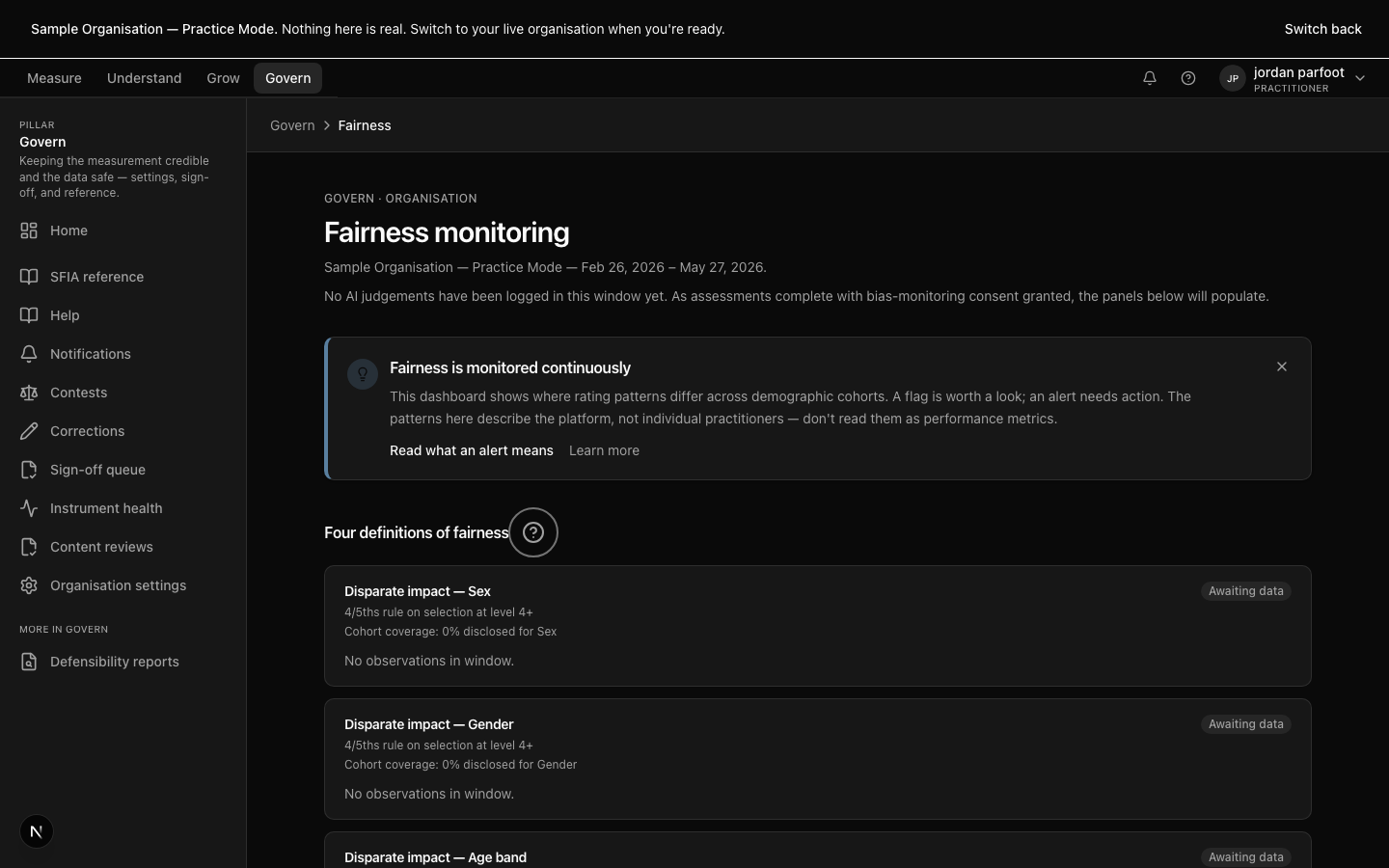
The fairness monitoring dashboard showing per-attribute bias signals over time, with anchored bands and the current sector threshold.

Continuous bias monitoring

Per protected attribute, with anchored "typical / worth a look / investigate" bands. The platform monitors fairness as operations, not as a feature — alerts surface to the trust and safety owner, not just to engineering.

Cohen's h thresholds per sector

Government and finance deployments use tightened thresholds (h ≥ 0.15 flag, h ≥ 0.25 alert). Corporate and education deployments use the standard band (h ≥ 0.20 flag, h ≥ 0.30 alert). Community deployments use the most signal-sensitive bands so smaller disparities surface earlier. Thresholds are platform-managed, not customer-tunable downwards.

The defensibility bundle

Every signed-off assessment can produce an evidence pack: the consent record, the evidence citations behind every rating, the sign-off chain, the AI provenance ledger entries, the calibration history of the practitioner, and any contest activity. The bundle is what a rating is defended with — in tribunal, in front of a regulator, or in a candid conversation with the person it describes.

Quarterly governance report

The trust and safety owner signs a quarterly report covering fairness signals, distress events, consent activity, contest outcomes, and AI provenance. The report is signed with HMAC-SHA256 and chained to the previous quarter — a tamper-evident record of the platform's safety posture over time.

Counterfactual audit harness

On a periodic cadence, the platform re-runs sample assessments with perturbed attributes to test whether ratings change in ways that should not be possible. Results feed the bias-monitoring surface and the governance report.

AI provenance and contestability

How the platform handles AI-derived ratings.

Every AI artefact has a row

Every AI-generated artefact — a rating recommendation, an evidence interpretation, a section of a draft report, an interview question — has a row in the provenance ledger. The row names the model, the prompt version, the input evidence, and the practitioner sign-off (or a note that no sign-off has happened yet).

The platform's AI interviewer is named Ava

Ava is named in copy because anonymising AI as "the system" quietly undermines disclosure. Ava does not pretend to be human, does not retain memory across sessions, and does not make rating decisions. When Ava reaches the edge of what she can do, she names that limit and refers the work to a person.

Every AI-derived rating is contestable

From any participant-facing surface, the contest pathway is one click away. The form asks what the rating was, what evidence the participant believes was missed, and what additional examples they would like considered. Every contest produces an audited decision with a written rationale, shared with the participant. A contest does not guarantee a rating change; it guarantees a review.

What the platform does not use AI for

The platform's AI does not make final rating decisions; practitioners do. It does not auto-approve sign-offs. It does not detect fraud or penalise particular answers. It does not share session content across organisations or participants. The AI provider can change without participant-visible disruption — the platform's behaviour is defined by these constraints, not by the underlying model.

Participant rights

Six rights, each one click from every participant surface.

View your data

See what the platform holds about you — consent records, evidence captured, ratings, report drafts, contest activity.

Correct factual errors

File a correction for any factual error. Corrections are reviewed and decided with a written rationale shared back to you.

Contest a rating

Challenge any AI-derived rating with additional evidence or context. Every contest is reviewed; the decision is recorded.

Request reassessment

Where the original assessment is no longer representative, request a fresh one. The platform tracks both for longitudinal analytics.

Manage your consent

Change consent preferences at any time. Changes apply forward; the platform tells you what happens to data already collected.

Request deletion

Request deletion of your data. The platform discloses what is retained for audit and why, with retention timeframes named at consent time and at deletion time — not in a different document.

Participant rights index

The participant rights index page — six rights laid out as a grid, each one click away.

Every participant surface carries the rights orientation banner. Crisis support is reachable from every participant surface.

Sector-specific safety overlays

Seven sector packs. Tone flexes; thresholds do not.

Sector packWhat it does differently
government-auAPS register. Tightened bias (h ≥ 0.15 flag, h ≥ 0.25 alert). Audit-ready logging. IRAP-equivalent posture. Australian data residency.
government-internationalJurisdiction-neutral register. Tightened bias. External audit required. Residency configured at deployment.
healthcare-trustClinical narration whitelist (distinguishes clinical narration of demanding work from personal distress). Mandatory reporting under the Health Practitioner Regulation National Law. Doctors4Doctors and Nurse & Midwife Support surfaced first.
education-brightDevelopmental register. Mandatory child-protection reporting. AITSL alignment. Kids Helpline and eheadspace surfaced first.
community-warmWarm register. Maximally sensitive distress detection. Australian community crisis lines (1800RESPECT, 13YARN) surfaced first. Indigenous-led overlay reviewed with an Indigenous cultural advisor.
corporate-formalDirect, time-respectful register. Balanced bias bands (h ≥ 0.20 flag, h ≥ 0.30 alert). Audit-ready logging. Corporate HR leadership review of cognitive-test inclusion.
finance-consideredPrecise, evidence-led register. Tightened bias (h ≥ 0.15). Australian data residency. Conduct and distress channels are kept separate — the platform never routes a distress disclosure as a conduct concern.

What we substantiate, and what we don't claim

Trust is earned by being honest about the boundary.

Substantiated
  • WCAG 2.1 AA as a design target enforced by primitives, not asserted in copy.
  • Hash-chain audit trail with HMAC-SHA256 signing on the quarterly governance report.
  • Published distress thresholds and published per-sector fairness thresholds.
  • Sector-tuned crisis referral with named services per deployment.
  • AI provenance ledger covering every AI-generated artefact.
  • Six named participant rights, each one click from every participant surface.
Not claimed
  • WCAG 2.1 AA certified — no third-party audit yet. The design target is met by primitive; the external certificate is not yet earned.
  • IRAP certified — the posture is built to be IRAP-equivalent; the certification itself is deployment-environment and customer-driven.
  • SOC 2 or ISO 27001 certified — these are deployment-environment-dependent and are not blanket claims for the platform.
  • Blockchain-immutable — the audit trail is hash-chained, which is different. We do not use a blockchain and we do not claim blockchain immutability.

This section earns trust by being honest about boundaries. If a claim is not on this page, you can assume the platform does not make it.

Read further, or talk to us.

The full design strategy — the same document the platform's design decisions are tested against — is publicly available. If you would like to discuss a deployment in your sector, please get in touch.