Capability measurement that holds up to scrutiny.
Interviews, simulations, and structured assessments that show what people can actually do — and ratings you can defend to a board, a regulator, or the person being rated. One platform, many instruments and frameworks, seven sector postures.
Four-pillar dashboard

Four pillars. One loop.
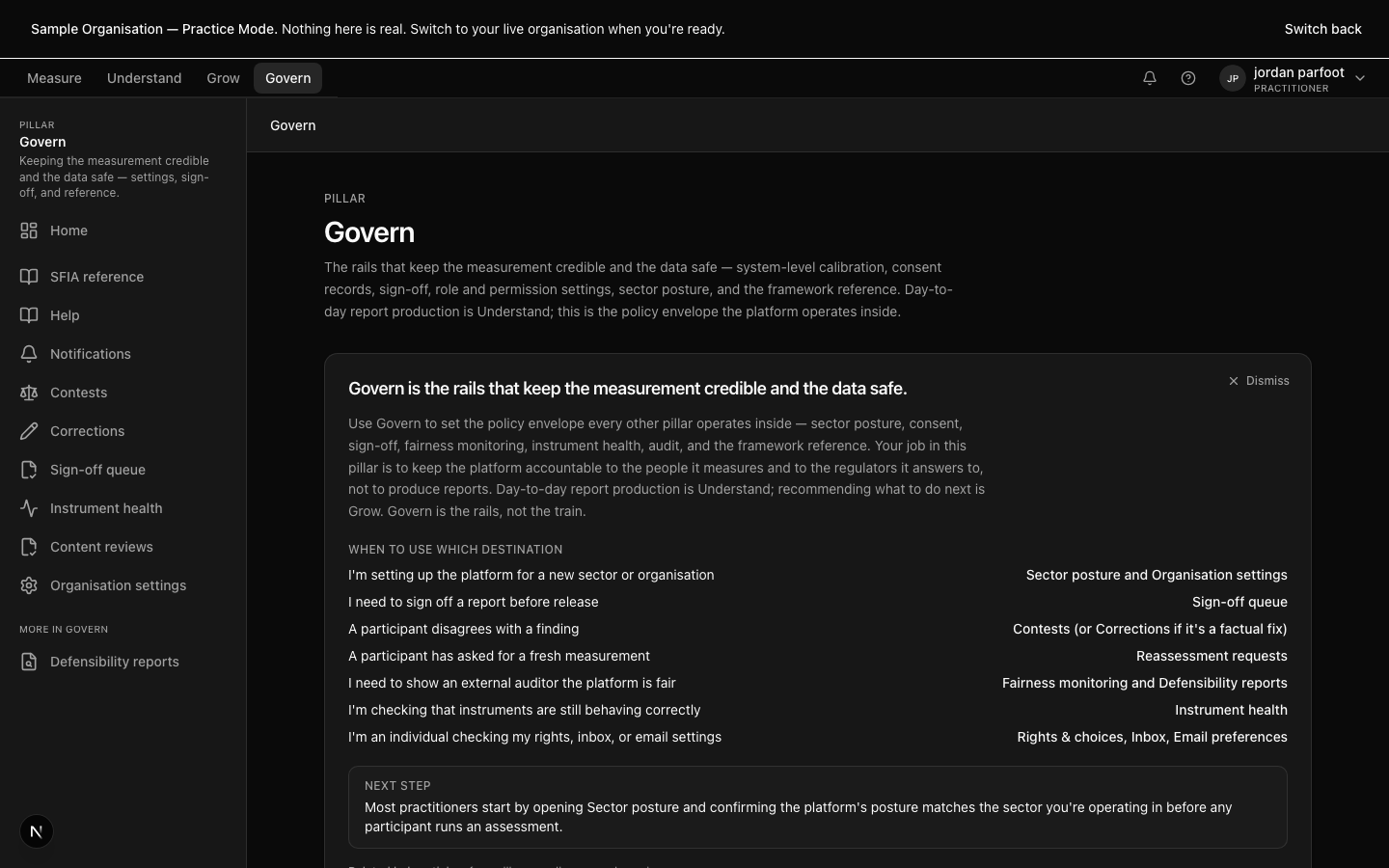
Measure → Understand → Grow, with Govern as the policy envelope around all three.
Measure pillar

Where capability evidence is produced.
Understand pillar

Where evidence becomes shared meaning.
Grow pillar

Where understanding becomes deliberate change.
Govern pillar

The rails that keep measurement credible and data safe.
Simulation library
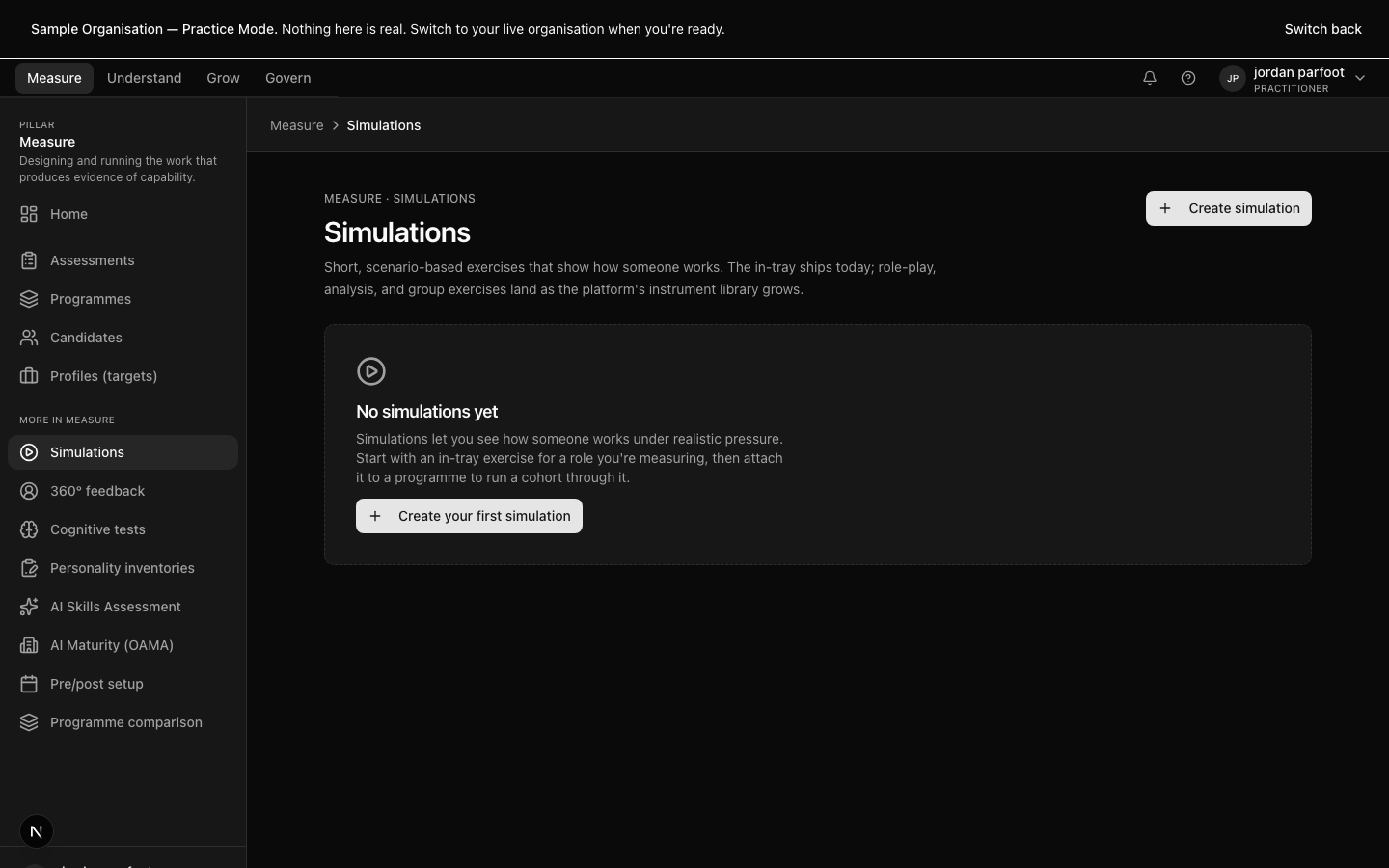
One instrument is rarely enough.
Different roles need different signals. The platform's instrument library covers structured interview, four kinds of simulation, cognitive ability, personality, 360-degree review, AI Skills, and organisational AI maturity (OAMA). Programmes orchestrate any combination of these around the same person or cohort — one consent envelope, one sign-off chain, one report.
Start from a template, or compose your own.
Programme templates encode sector tone, consent shape, sign-off chain, and instrument mix for recurring use cases — APS EL2 capability review, graduate analyst cohort, post-incident healthcare reassessment, community services induction, educator professional learning, APRA conduct fitness. Each template carries a reviewer note naming the sector practitioner who must sign off before deployment.
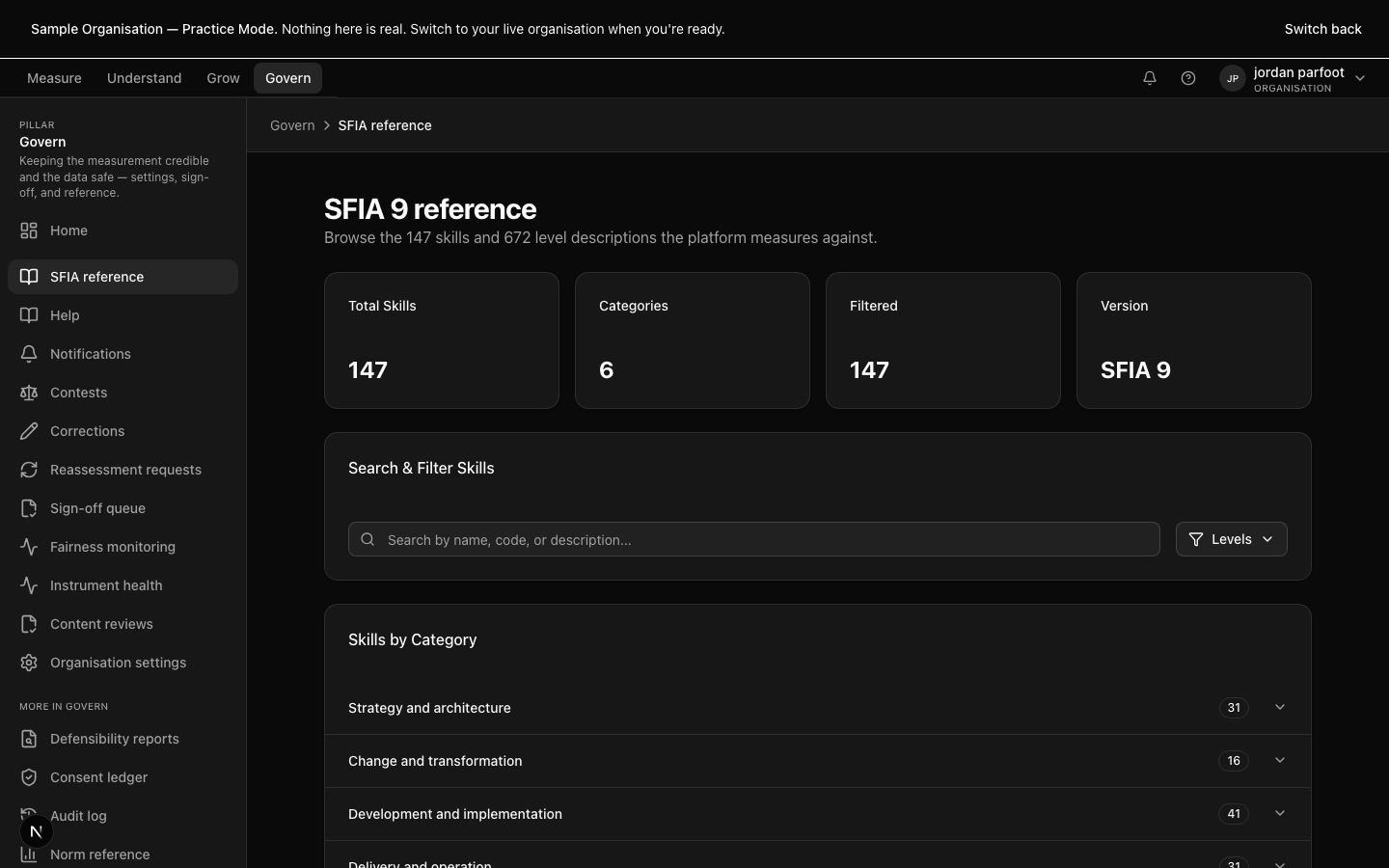
SFIA is the largest of N — not the only one.
Capable was built on the Skills Framework for the Information Age. SFIA 9 remains the platform's deepest framework — all 147 skills, all 7 responsibility levels, all attribute dimensions. Alongside SFIA we support the APS AI Capability framework (AISA) — AI capability levelled on the same SFIA scale with APS-classification equivalents — plus leadership frameworks, partner competency models, and customer-supplied custom frameworks. The framework picker sits upfront on every assessment and every programme — practitioners choose the framework that fits the work, not the other way around.
Our SFIA heritage.
The platform started life as a SFIA 9 interview tool. The SFIA depth — descriptors at every level, attribute mapping, level-aware questioning — is still here. What changed is that SFIA is now one framework in a library, not the only lens.
See the SFIA 9 frameworkSFIA 9 framework reference
One platform, seven sector postures.
Each sector pack adjusts tone, consent shape, distress thresholds, crisis referral, and audit posture. Practitioners do not write sector copy ad hoc — the pack carries the platform-managed defaults; named sector practitioners sign off the pack before any deployment.
Government (Australia)
Formal-considered. APP / Privacy Act framing. APS deployment partner sign-off before launch.
Government (International)
Per-jurisdiction land acknowledgement, crisis services, data residency, and privacy-regime framing.
Community / NFP
Warm, unhurried, trauma-informed. Indigenous-led overlay reviewed with an Indigenous cultural advisor.
Healthcare
Clinical narration whitelist. Doctors4Doctors and Nurse & Midwife Support surfaced first. Clinical lead sign-off.
Education
Developmental framing. Safeguarding lead sign-off. Working-with-children verification for assessor reviewers.
Corporate
Direct, outcome-oriented, time-respectful. Corporate HR leadership review of cognitive-test inclusion.
Finance / Regulated
Precise, evidence-led, audit-ready. APRA / ASIC alignment review before deployment.
Sector posture configuration
Sector posture is configured by the organisation at deployment and reviewed against the sector pack defaults. The pack is platform-managed; named sector practitioners sign off before launch.
Find your sectorCapability measurement is high-stakes. We treat it that way.
A rating shapes hiring, promotion, registration, certification, secondment. The platform's name is also its standard: trust is earned by what can be produced when a rating is questioned, not by what is asserted up front.
Trust and safety landing

Defensibility bundle
Every signed-off assessment can produce an evidence pack for tribunal, regulator, or audit: consent record, evidence citations, sign-off chain, AI provenance, calibration history, and any contest activity.
AI provenance ledger
Every AI-derived rating links to the prompt that produced it, the evidence it drew on, and the human who signed it off. Contestable on the participant side, traceable on the practitioner side.
Fairness monitoring
Continuous bias monitoring per protected attribute, with sector-tuned thresholds. Alerts framed as signals to investigate, not verdicts. Quarterly governance report signed by the trust and safety owner.
Participant rights
Contest, correction, reassessment, and withdrawal — one click away from any participant surface. Rights are named in the consent record, not buried in terms.
Trauma-informed by construction
Pause, step-away, and withdraw without penalty. Sector-tuned distress detection and crisis referral. Consent is layered and revisitable, not bundled at the start.
How we talk matters.
The platform addresses participants in a warm-plain register, practitioners in a formal-considered register, organisational leaders in a strategic-precise register, and trust and safety owners in a formal-precise register. Sector overlays flex register without lowering safety floors. The voice doctrine forbids exclamation marks, marketing hype, infantilising language, and any framing that celebrates capability gaps. A rating sentence reads the same to the participant it describes as it does to the assessor who signed it.
- Five principles
- Truthful, power-aware, plain, warm without performing, specific.
- Anti-pattern catalogue
- No "awesome answer", no "hit the ground running", no "don't miss out", no emoji in success copy.
- Named AI
- The platform's AI interviewer is named Ava and disclosed up front. No pretence of being human.
Three audiences. One spine.
Account type determines mode. A practitioner who is also a participant in a leadership programme switches context, not identity.
Sectors we serve
Seven sector content packs, each with named practitioner sign-off before deployment.
- Government (Australia)
- Government (International)
- Community / NFP
- Healthcare
- Education
- Corporate
- Finance / Regulated
Honest about what's mature and what's developing.
Truthfulness is the first principle of the platform's voice doctrine. It applies to the marketing page too. Here is what's solid today and what's still being built.
Mature today
- SFIA 9 interview with adaptive questioning and evidence extraction.
- Evidence citation, attribute mapping, and inferred-skills surfacing.
- Strength-first report drafting with practitioner edit and sign-off.
- Four simulation formats, 360-degree feedback, cognitive, personality, AISA, and OAMA — orchestrated by multi-instrument programmes.
- Integration sessions for multi-assessor consensus, and evidence search across the organisation's record.
- Workforce planning — capability baseline, gap and floor views, supply-drift scenarios, and internal mobility.
- Fairness monitoring with sector-tuned thresholds and quarterly governance reports.
- Sandbox practice mode for calibration and onboarding.
- Seven sector content packs with platform-managed defaults.
Still developing
- Custom framework loaders — the picker is in place; the framework data is configured per organisation.
- Full participant-facing translation across all five locales — Mandarin and Vietnamese are stubbed for translator review.
- Provider abstraction so the underlying AI engine can change without surface changes — this matters because we expect it to change.
Request a walkthrough.
We work with deployment partners, not anonymous customers. A walkthrough is the right next step — we will show you the platform against your sector and your frameworks, not a generic demo.