Pillar

Measure

Measure is where evidence of capability is produced — interviews, simulations, cognitive tests, personality inventories, 360s, AI-skills checks, and the programmes that bundle them. Reading what came back is Understand; recording consent or signing off is Govern. Measure stops the moment the evidence is captured.

The Measure overview — assessments in flight, programmes running, instruments available

The Measure overview — assessments in flight, programmes running, instruments available
The Measure pillar overview lists every assessment in flight, every programme running, and every instrument available in your sector.

What this pillar is for

The work in Measure is commissioning the right instrument for the question you're trying to answer, sending it to the right people, and confirming the sessions are running. That sounds prosaic, and it is — the discipline is in choosing the instrument deliberately, not in stacking instruments because the platform supports them. One person, one decision is almost always one interview. A cohort moving through a leadership review is several instruments around the same target. A pre/post study is an instrument run twice with a gap between.

Every instrument the platform ships produces evidence in a shape Understand can read. That shape is consistent across instruments — a transcript or a captured behaviour, the skills the platform identified, the level the evidence sits at, the confidence the platform has, and the audit trail for how all of that was produced. This consistency is what makes triangulation possible later, and what keeps the platform from becoming a collection of bespoke surfaces glued together.

Measure also owns the programme — the container that orchestrates several instruments around one participant or one cohort. A programme inherits one consent envelope, one sign-off chain, and one report shape. Programmes are how the platform turns a sequence of instruments into a coherent measurement, rather than a stack of separate ones.

What sits here

SFIA interview

A structured competency conversation against SFIA 9 or a custom framework.

Ava — the platform's AI interviewer — runs a multi-turn conversation using the STAR method against the target skills and levels. Questions adapt to the response in front of them: when an answer is thin, Ava probes for a concrete example; when it is rich, she moves to a different area. Evidence is extracted while the conversation runs.

Practitioners can shadow the interview in real time, send invisible nudges to steer the conversation, and watch the evidence tracker update. Candidates are told in their welcome that an assessor may be observing. The interview is a recording, a transcript, and a structured evidence bundle — not just a chat log.

SFIA interview — A structured competency conversation against SFIA 9 or a custom framework.
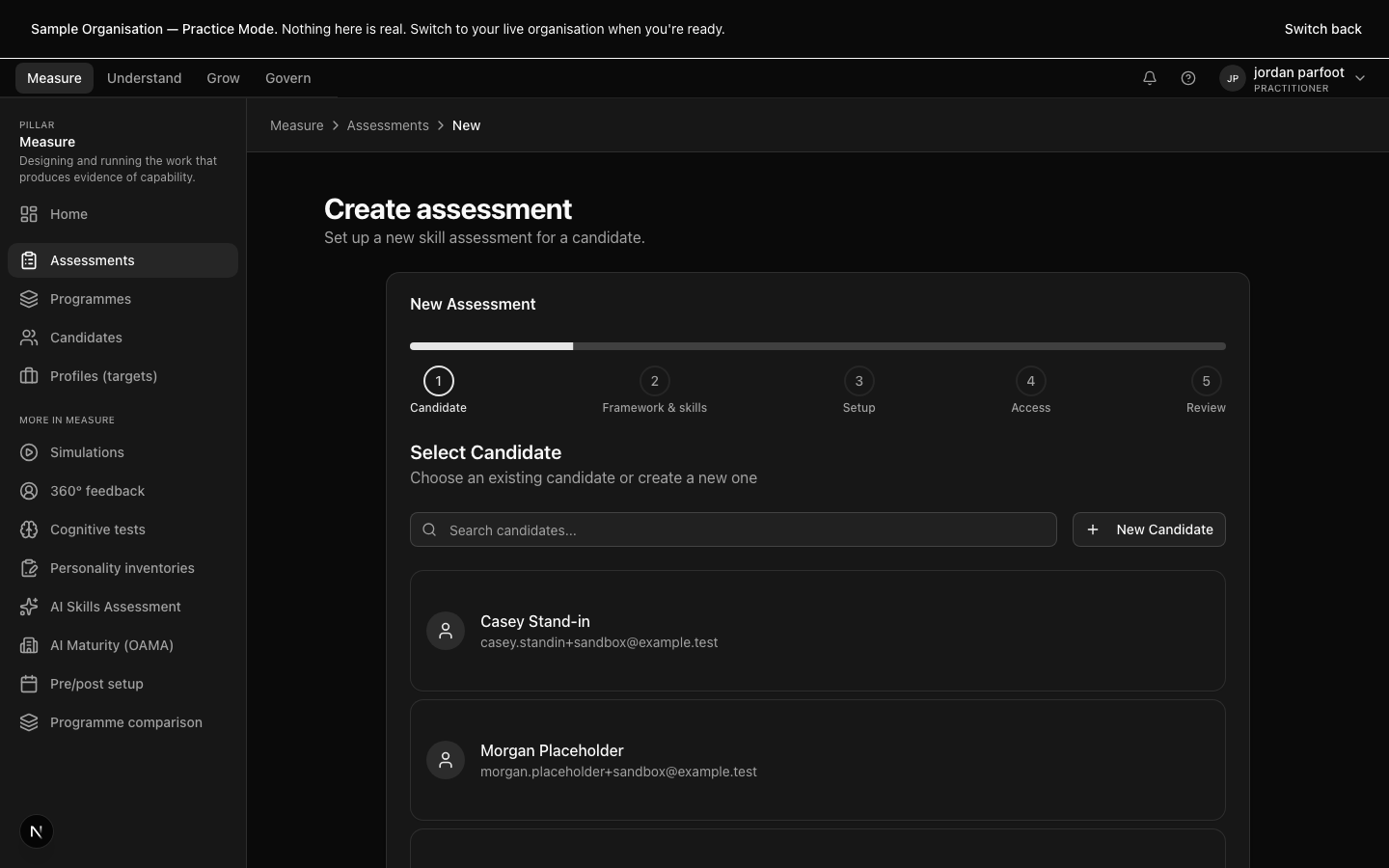
SFIA interview — A structured competency conversation against SFIA 9 or a custom framework.
Programmes

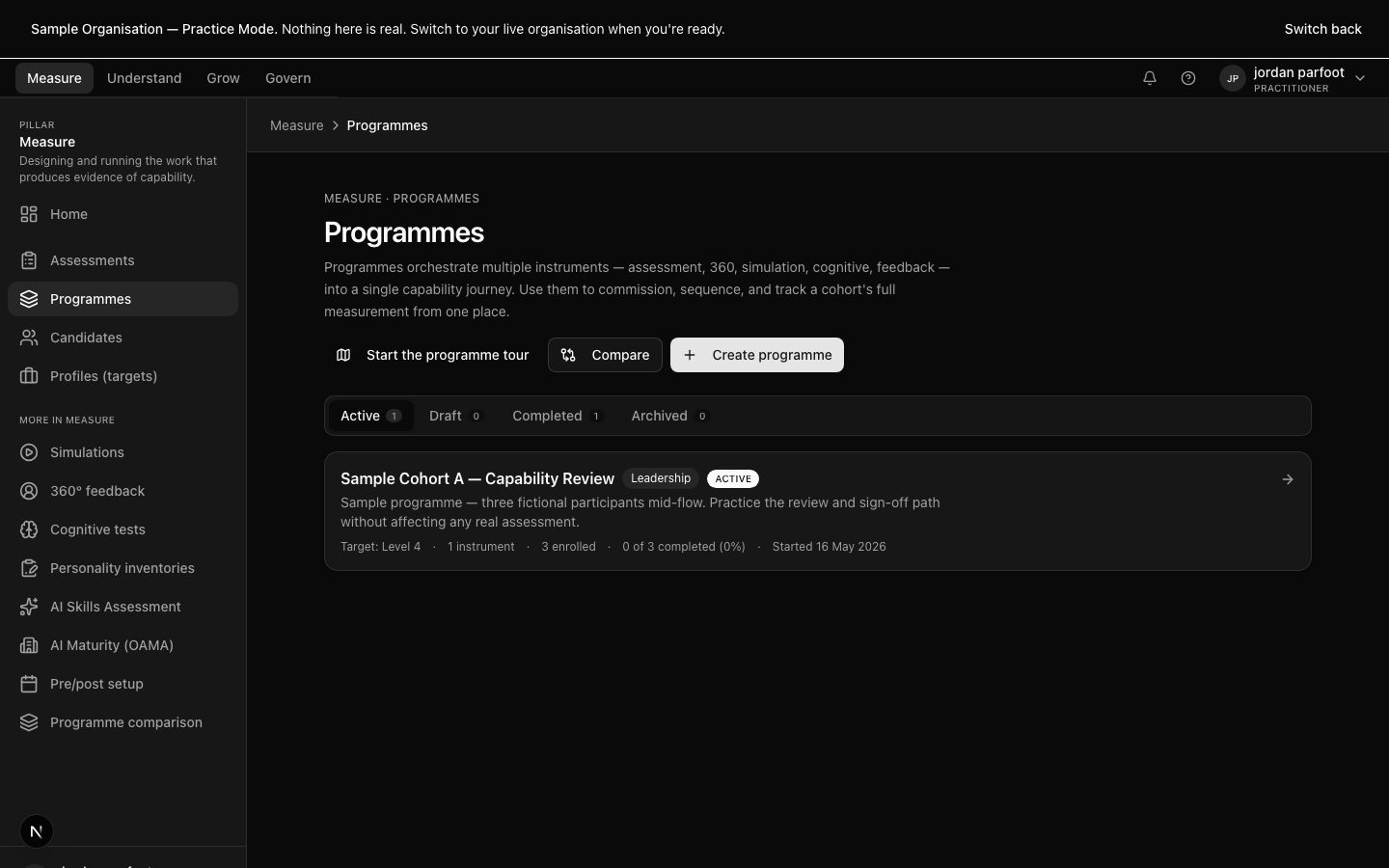
Multi-instrument capability journeys for one person or one cohort.

A programme sequences instruments — interview, simulation, cognitive, personality, 360, AI Skills — around the same target. Six sector-keyed templates ship in the gallery (APS EL2 review, graduate analyst cohort, post-incident healthcare reassessment, and others). Each template encodes the instrument mix, the sign-off chain, and the consent shape its sector requires.

Programmes can be cohort-shaped or individual-shaped. A cohort programme moves a group through the same sequence; an individual programme stacks several instruments around one person. Pre/post measurement can be attached at the programme level, with the platform tracking the delta as the cohort moves through it.

Programmes — Multi-instrument capability journeys for one person or one cohort.

Programmes — Multi-instrument capability journeys for one person or one cohort.

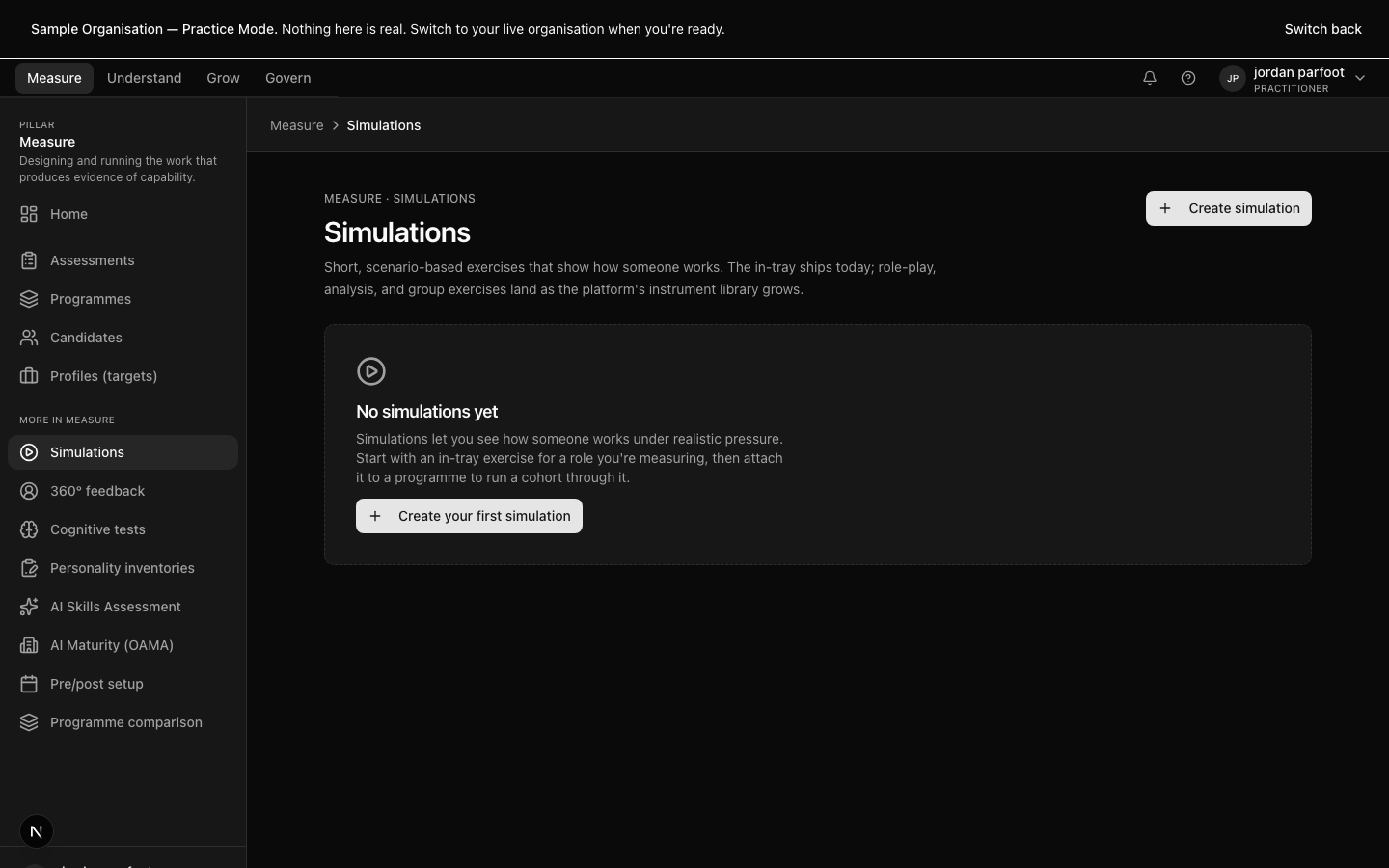
In-tray simulation

A timed inbox triage — judgement under volume.

Participants receive a fictional inbox with twelve to fifteen items competing for attention. They prioritise, reply, escalate, or defer, with their actions captured as evidence. The simulation isn't graded on the "right" prioritisation; it is graded on the reasoning the participant exposed.

Observer notes can be added in real time by a practitioner, and the AI extracts structured evidence after the session ends. The output sits alongside other instruments in the participant's capability profile.

In-tray simulation — A timed inbox triage — judgement under volume.

In-tray simulation — A timed inbox triage — judgement under volume.

Role-play simulation

A multi-turn conversation with an AI persona.

The scenario sits the participant opposite an AI character — a difficult stakeholder, a struggling team member, a regulator asking pointed questions. The persona is consistent across the conversation: it has goals, constraints, and reactions that the participant must work with.

Practitioners shape the scenario from a library of templates or author their own. Behaviour evidence is captured as the conversation runs, then triangulated against the rest of the participant's record. Role-play surfaces judgement under interpersonal pressure in a way an interview alone rarely does.

Role-play simulation — A multi-turn conversation with an AI persona.

Role-play simulation — A multi-turn conversation with an AI persona.

Analysis-presentation simulation

A brief, a recommendation, and a panel.

The participant receives a written brief — usually a board paper or a case study — analyses it inside a time-box, then presents a recommendation to a simulated panel. The platform captures the written analysis and the verbal recommendation.

This is the instrument the platform reaches for when the question is "can this person reason through ambiguity and defend a position." It is paired with cognitive ability and with role-play when the role involves frequent senior-stakeholder exposure.

Analysis-presentation simulation — A brief, a recommendation, and a panel.

Analysis-presentation simulation — A brief, a recommendation, and a panel.

Group exercise

Leaderless group with structured observer rating.

Four to six participants work a shared task with no assigned leader. An observer — practitioner or trained rater — captures behavioural evidence against a structured rubric, and the platform aggregates the observer notes alongside any AI-extracted signal from the session transcript.

Group exercises produce evidence about collaboration, influence, and conflict navigation that no individual instrument reaches. The rubric is sector-keyed; the platform's APS pack and corporate pack ship different defaults.

Group exercise — Leaderless group with structured observer rating.

Group exercise — Leaderless group with structured observer rating.

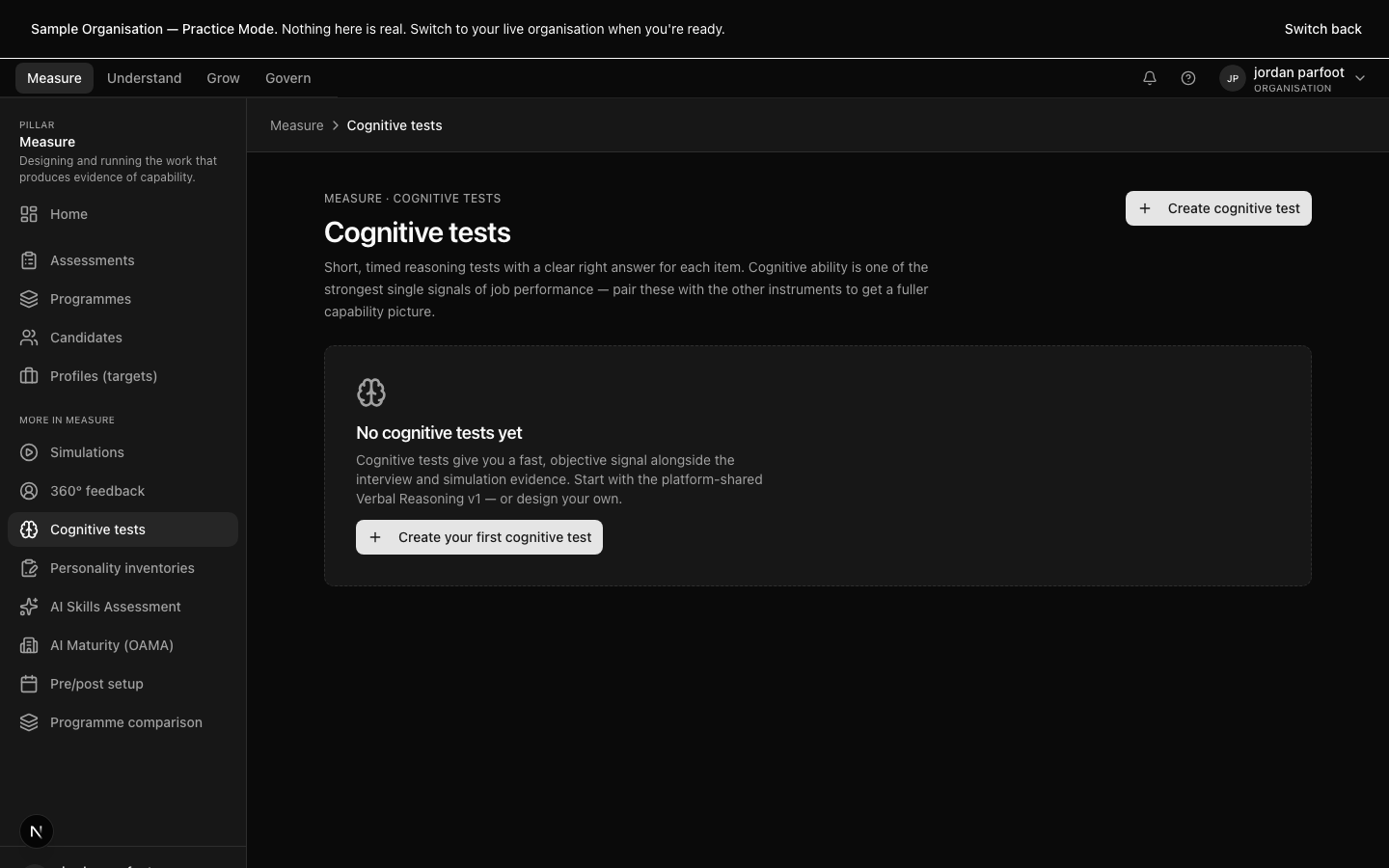
Cognitive ability test

Short, timed reasoning with a clear right answer per item.

The platform's cognitive surface ships verbal reasoning today, with numerical, abstract, and situational-judgement variants on the roadmap. Items are adaptive at the item level — the test calibrates to the participant's responses as it runs — and the report carries a reliability flag when the response pattern suggests the score is unstable.

Cognitive ability is one of the strongest single predictors of job performance, and one of the easiest instruments to misuse. The platform's report shows the score against a norm reference the practitioner can choose, names the reliability band, and refuses to release the score below the platform's confidence floor.

Cognitive ability test — Short, timed reasoning with a clear right answer per item.

Cognitive ability test — Short, timed reasoning with a clear right answer per item.

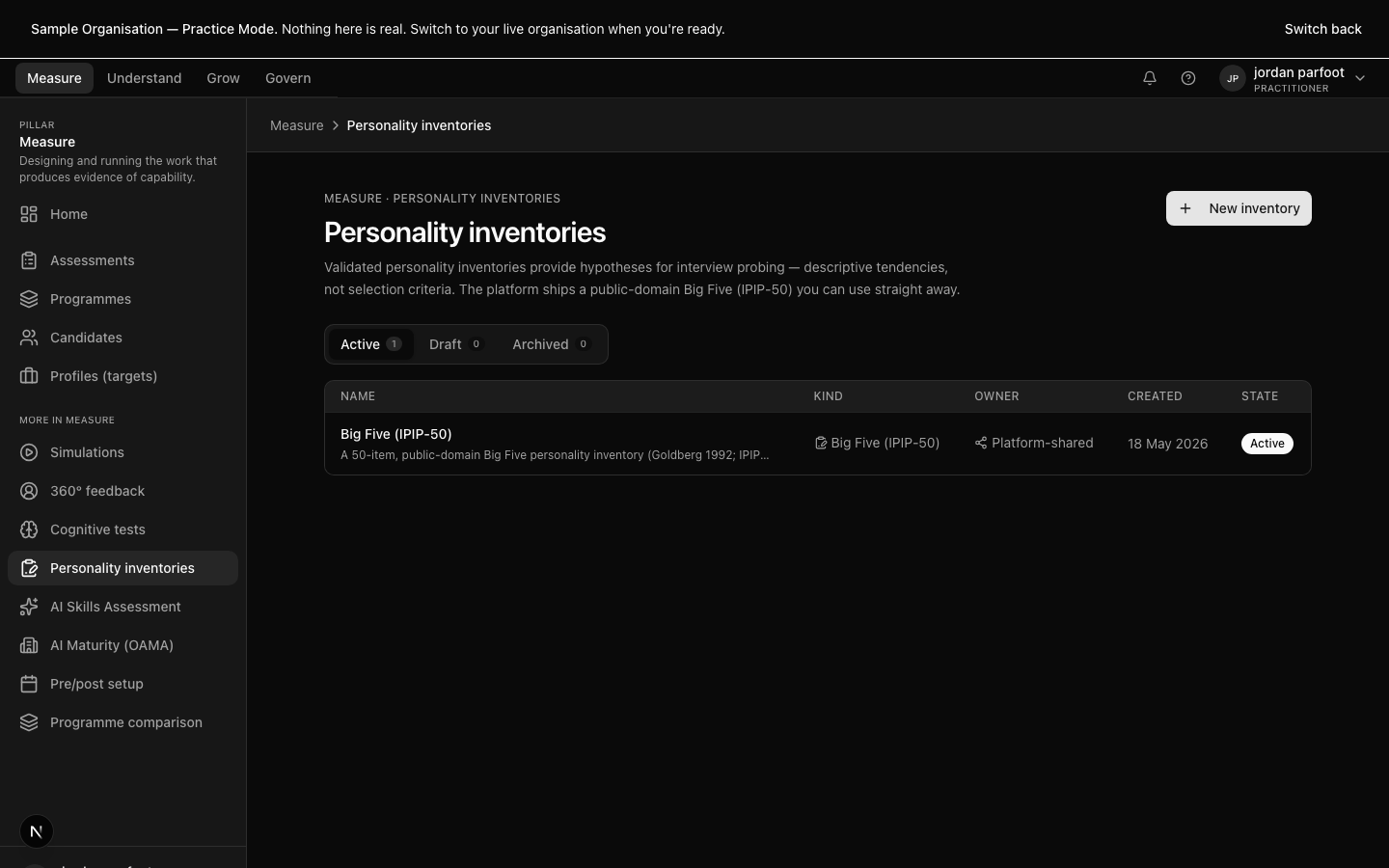
Personality inventory

Big Five (IPIP-50) — descriptive tendencies that shape the interview.

The platform's personality surface is the IPIP-50 — fifty Likert-scale items producing five descriptive bands across openness, conscientiousness, extraversion, agreeableness, and emotional stability. Output is descriptive, never prescriptive: the report frames the five bands as tendencies the interview can probe against, not as criteria for selection.

Practitioners reach for the personality inventory when they want to triangulate the interview against a separate signal. The platform refuses to surface personality as a hiring decision threshold; it surfaces it as a frame for asking better questions.

Personality inventory — Big Five (IPIP-50) — descriptive tendencies that shape the interview.

Personality inventory — Big Five (IPIP-50) — descriptive tendencies that shape the interview.

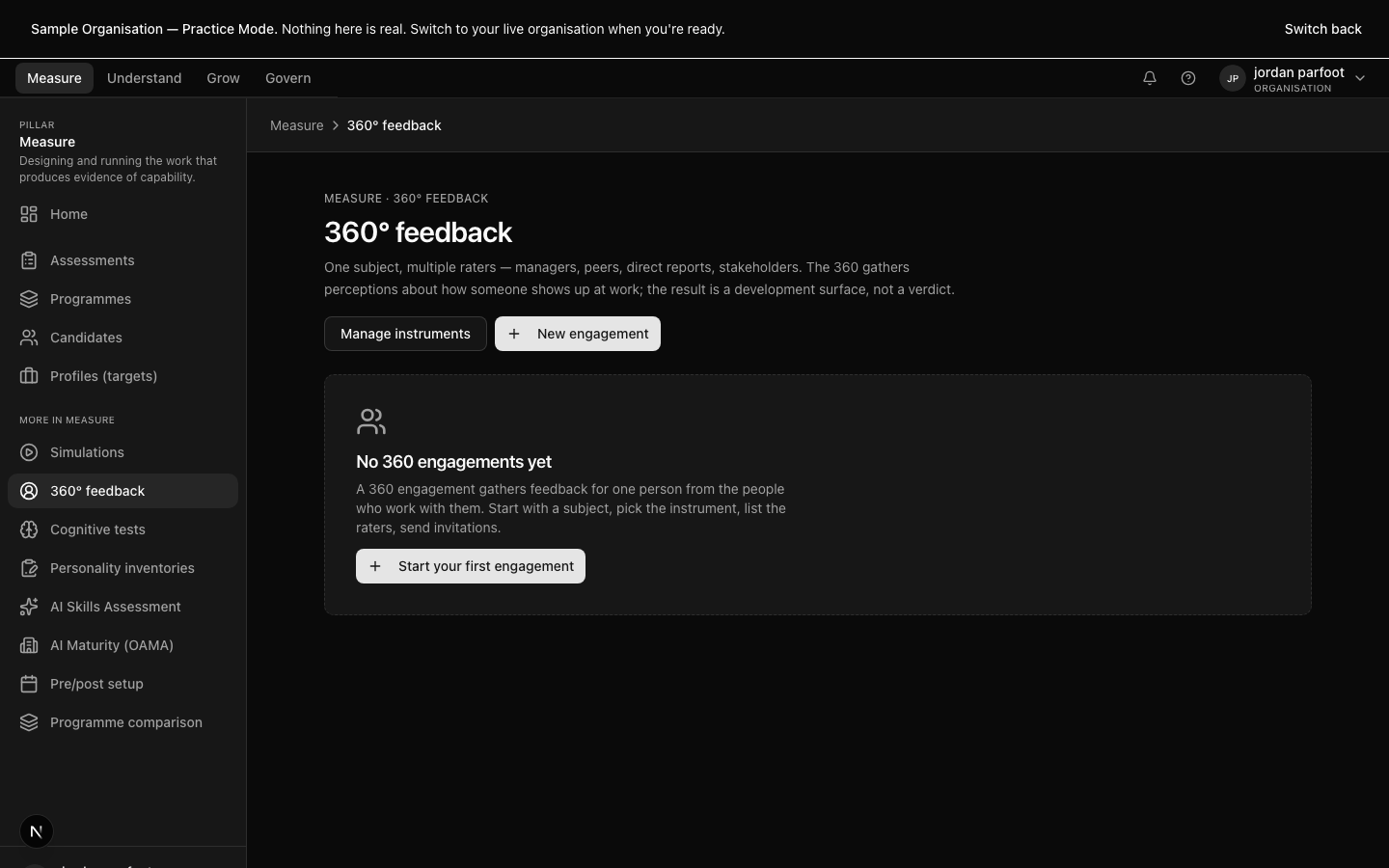
360-degree feedback

Multi-rater feedback for one subject.

Managers, peers, direct reports, and stakeholders rate the subject against a sector-keyed rubric. The platform aggregates the responses with an anonymity-preserving suppression threshold — fewer than three raters in a category, no per-category breakdown.

360s are the instrument the platform reaches for when the question is "how does this person actually land with the people around them" — a question the interview alone never answers. Output sits in the capability profile alongside every other instrument.

360-degree feedback — Multi-rater feedback for one subject.

360-degree feedback — Multi-rater feedback for one subject.

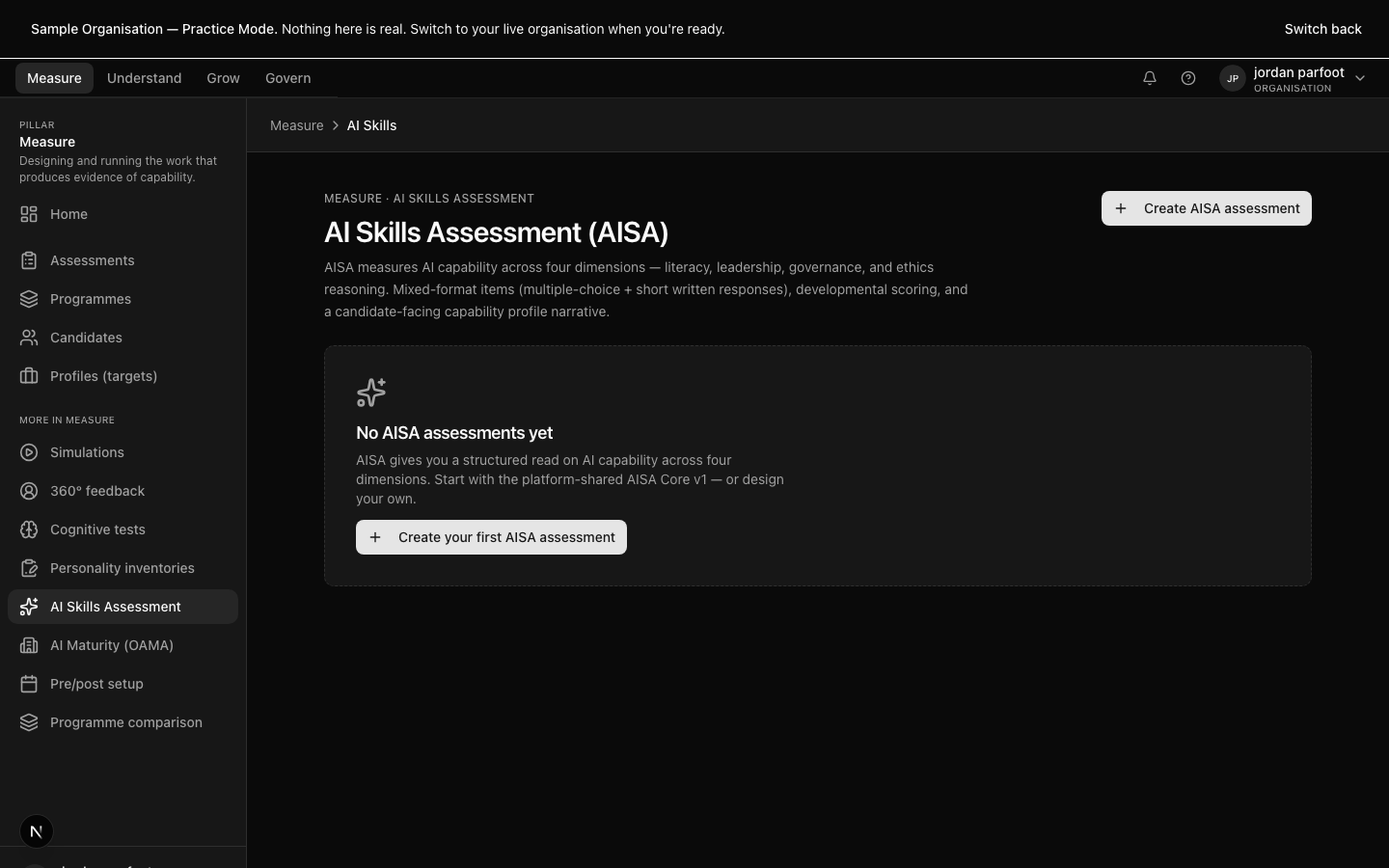
AI Skills Assessment (AISA)

AI capability across literacy, leadership, governance, ethics reasoning.

AISA measures four dimensions of working with AI — basic literacy, the leadership of AI work, governance and policy literacy, and ethics reasoning under realistic constraint. Items mix multiple-choice with short-form responses; the short-form items are AI-scored against a developmental rubric, with practitioner review for the cases that need it.

AISA is the instrument the platform offers when the question is whether an individual can lead AI-enabled work — not whether they can write a prompt. Output is developmental: the four bands name where the participant is and what the next band looks like.

AI Skills Assessment (AISA) — AI capability across literacy, leadership, governance, ethics reasoning.

AI Skills Assessment (AISA) — AI capability across literacy, leadership, governance, ethics reasoning.

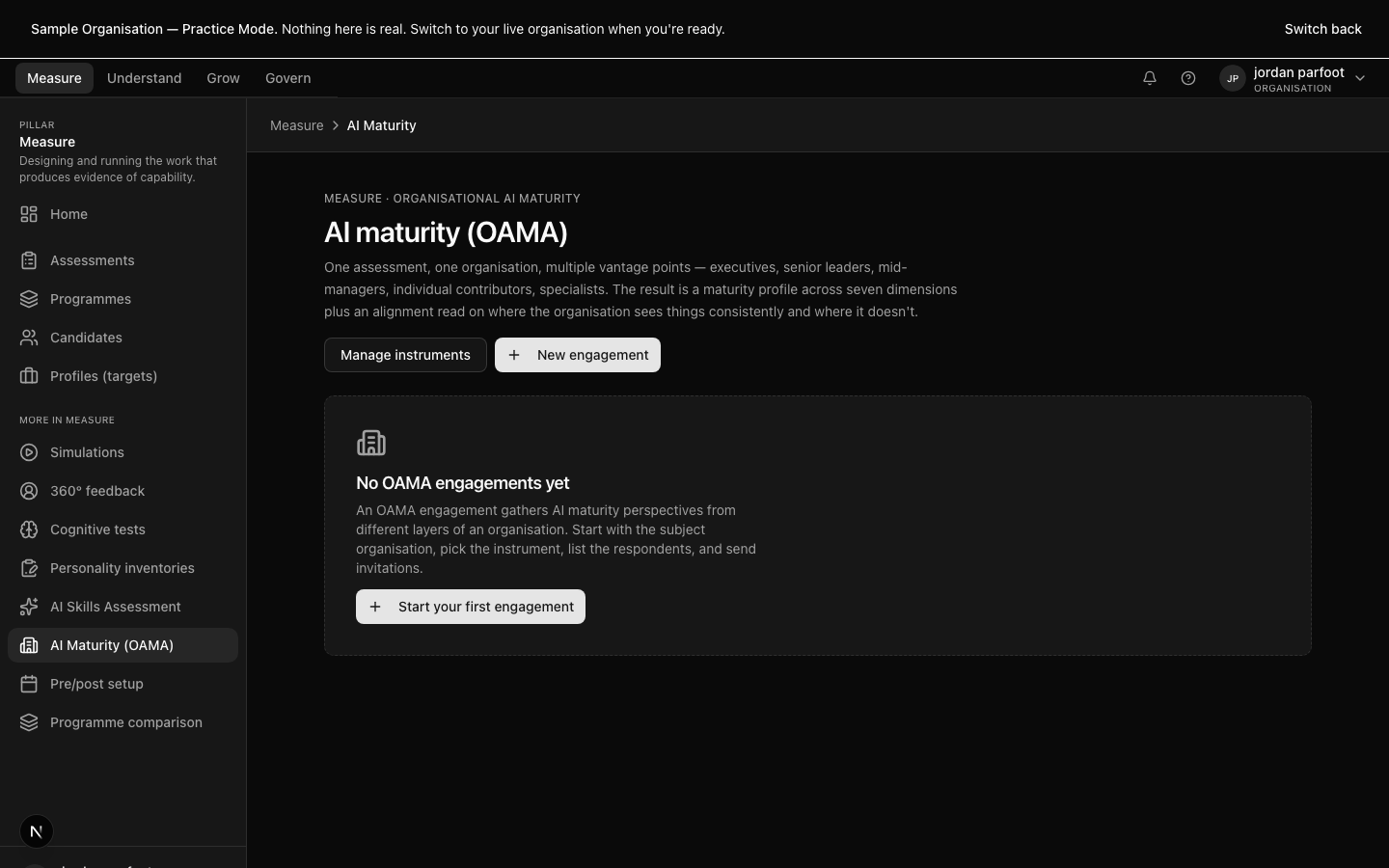
Organisational AI Maturity (OAMA)

Organisation-wide maturity across seven dimensions.

OAMA evaluates an organisation, not a person. Seven dimensions — strategy, data, talent, governance, ethics, culture, infrastructure — each evidenced through a short questionnaire administered to executive, leader, and on-the-floor cohorts. The platform weights the perspectives and produces a maturity narrative per dimension plus an overall position.

OAMA is the discovery instrument when an organisation is asking "are we ready to scale AI work, and where will it fall over." The narrative is sector-tuned and traceable to the underlying responses; the report is built to be defended to a board.

Organisational AI Maturity (OAMA) — Organisation-wide maturity across seven dimensions.

Organisational AI Maturity (OAMA) — Organisation-wide maturity across seven dimensions.

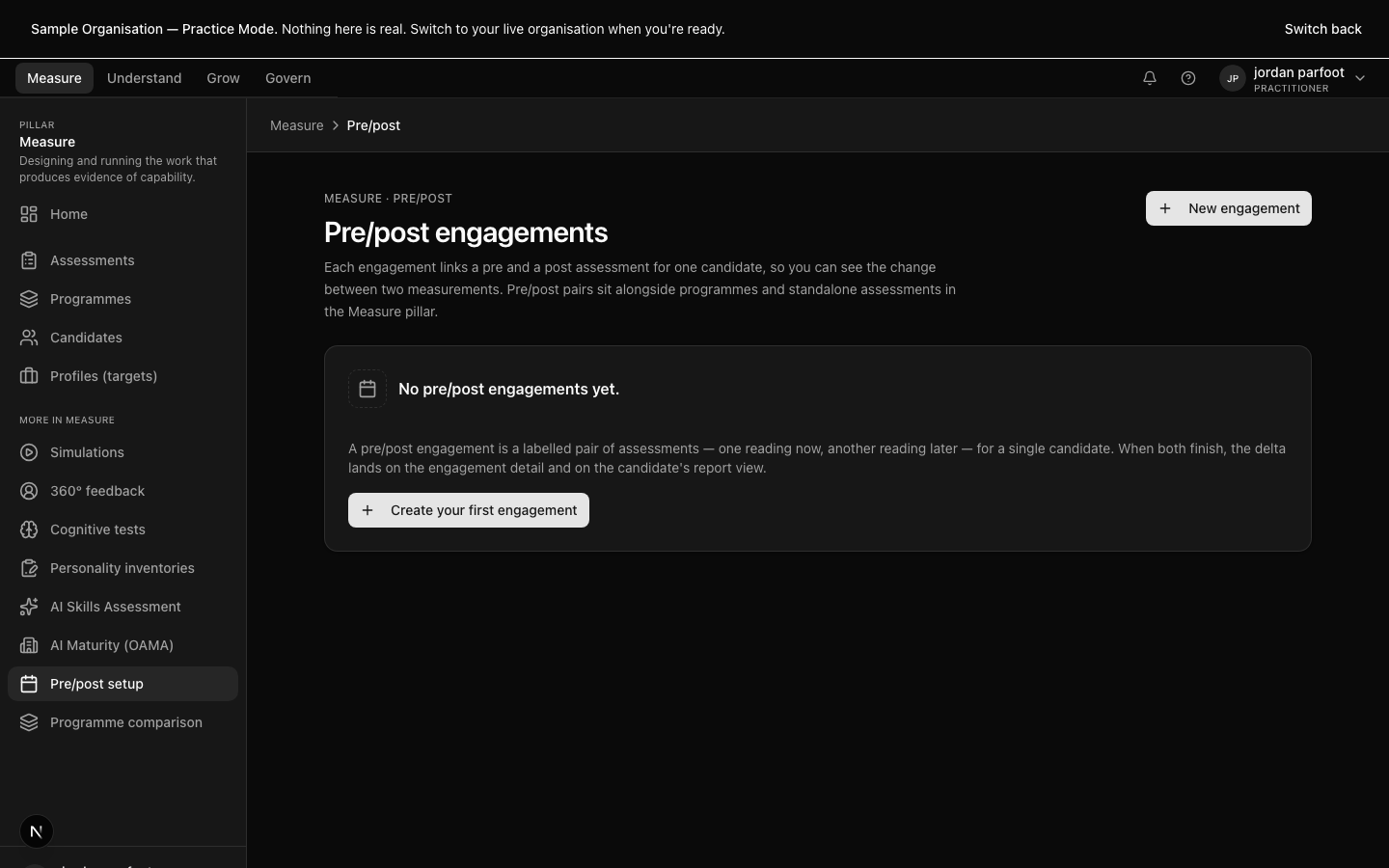
Pre/post measurement

A baseline now, a re-measure later.

The platform pairs an instrument run today with the same instrument run later, then surfaces the delta. The pairing is at the programme level — a leadership programme might pre/post the 360, a graduate programme might pre/post the cognitive and AISA.

Pre/post is the answer to "did the intervention move the dial." Outputs roll up into programme outcomes and into Grow's longitudinal progress.

Pre/post measurement — A baseline now, a re-measure later.

Pre/post measurement — A baseline now, a re-measure later.

When to use which destination

If you can name which instrument the question needs, the platform is two clicks away from running it.

I need to assess one person against a defined skill set.
Open Assessments and create a SFIA interview.
I need to run several instruments around the same person or cohort.
Open Programmes and start from a template.
I need to define the target a person is being measured against.
Open Profiles and pick the role profile, or build a custom one.
I need to put a behavioural decision in front of someone.
Open Simulations — in-tray, role-play, analysis, or group.
I need 360-degree feedback from peers and managers.
Open the 360 destination.
I need cognitive ability or personality data alongside the interview.
Open the relevant test destination, or attach it to a programme.
I need a baseline before training and a re-measure after.
Attach pre/post measurement to a programme.
I need to evaluate an organisation, not a person.
Open OAMA.

How this pillar connects to the other three

Measure produces evidence and stops the moment the evidence is captured. The evidence flows into Understand, where it becomes a defensible reading, and into Grow when the reading becomes a development plan. Govern sits across the top — sector posture, consent, and sign-off shape what Measure can run and how it runs. Measure also receives signal back from Grow: a re-measurement scheduled in Grow returns the participant to a Measure session, which is how the loop closes.

See it live

We'll walk you through the surfaces above on a deployment that matches your sector.