Pillar

Grow

Grow is where understanding becomes deliberate change. Convert a participant's reading of their capability into a development plan, goals, learning resources, and visible progress over time. Running a new assessment lives in Measure; approving the plan lives in Govern. Grow is the forward-motion pillar only.

The Grow overview — development plans, my goals, recommendations, passport, longitudinal progress

The Grow overview — development plans, my goals, recommendations, passport, longitudinal progress
The Grow pillar overview gathers the forward-motion surfaces — plans, goals, recommendations, the passport, and the progress views.

What this pillar is for

The work in Grow is forward motion — for an individual, a cohort, or an organisation closing a capability gap. A development plan in Grow is anchored in the rating evidence from Understand, structured around the 70/20/10 framing (on-the-job stretch, social learning, formal learning), and owned by the participant. The practitioner drafts; the participant accepts or amends; both can see the same plan.

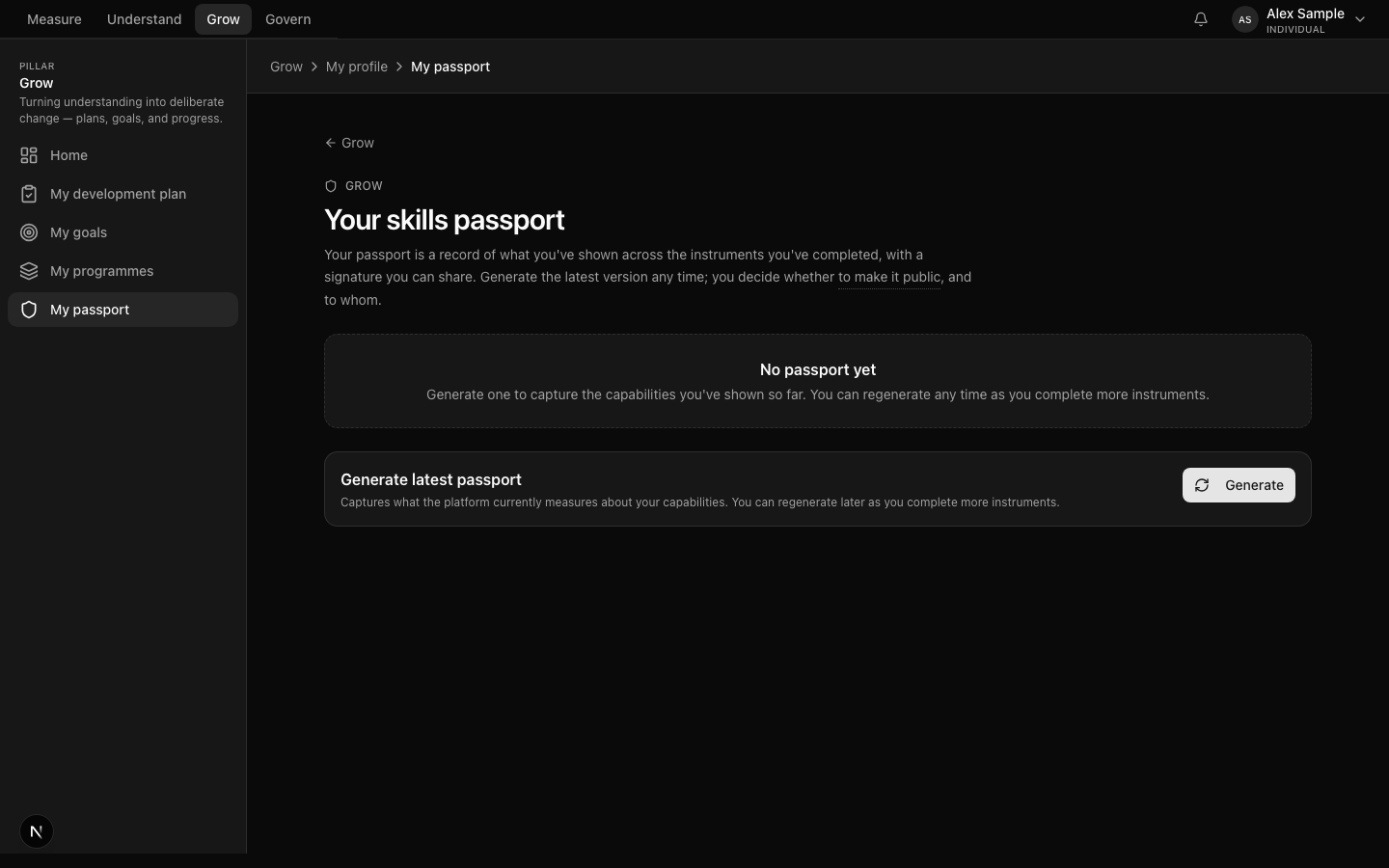
Grow is also where the Skills Passport lives. The passport is the participant's portable record of what they have shown across the platform — interview ratings, simulation evidence, cognitive percentile, 360 perspectives, AISA bands. It is signed (HMAC), verifiable by a third party through a public verifier, and translatable across SFIA, ESCO, and O*NET. The participant keeps the key; the organisation can issue but cannot revoke.

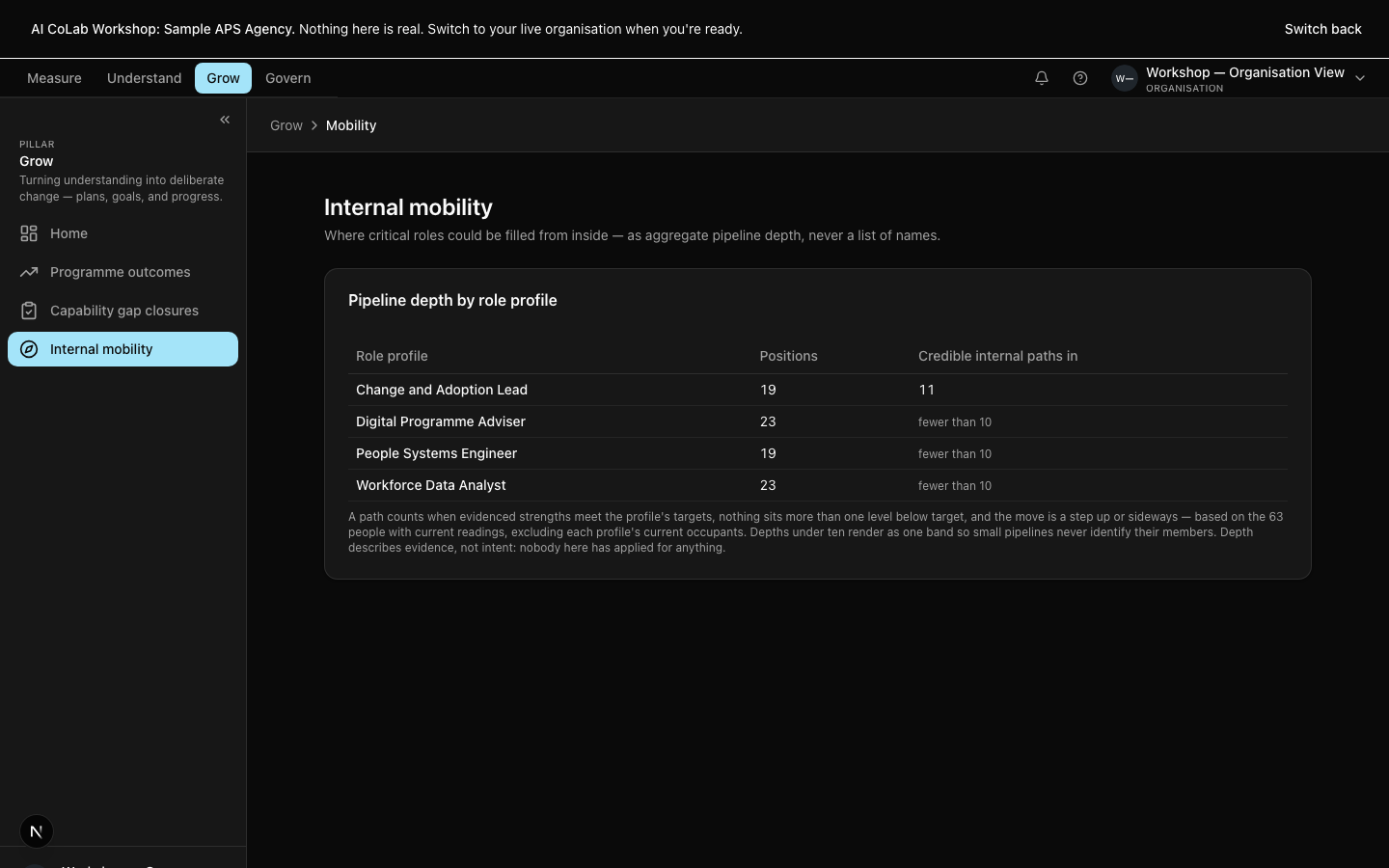
Longitudinal progress, programme outcomes, and capability gap closures are the aggregate views in Grow. They answer the question every workforce-development conversation eventually reaches: did the effort move the dial. The platform's posture is to make that question answerable by evidence, not by self-report.

What sits here

Development plans

70/20/10 plans anchored in evidence and owned by the participant.

A development plan in Capable starts where the report ended — the strengths to extend, the areas with thinner evidence, the level the participant is reaching for. The plan is drafted by the practitioner, accepted or amended by the participant, and visible to both from then on.

The 70/20/10 structure shapes the plan: roughly 70 per cent on-the-job stretch, 20 per cent social learning (coaching, peers, communities), 10 per cent formal learning (courses, reading, structured study). The platform doesn't enforce the ratio; it surfaces it as a frame so the plan reaches beyond "go on a course."

Development plans — 70/20/10 plans anchored in evidence and owned by the participant.
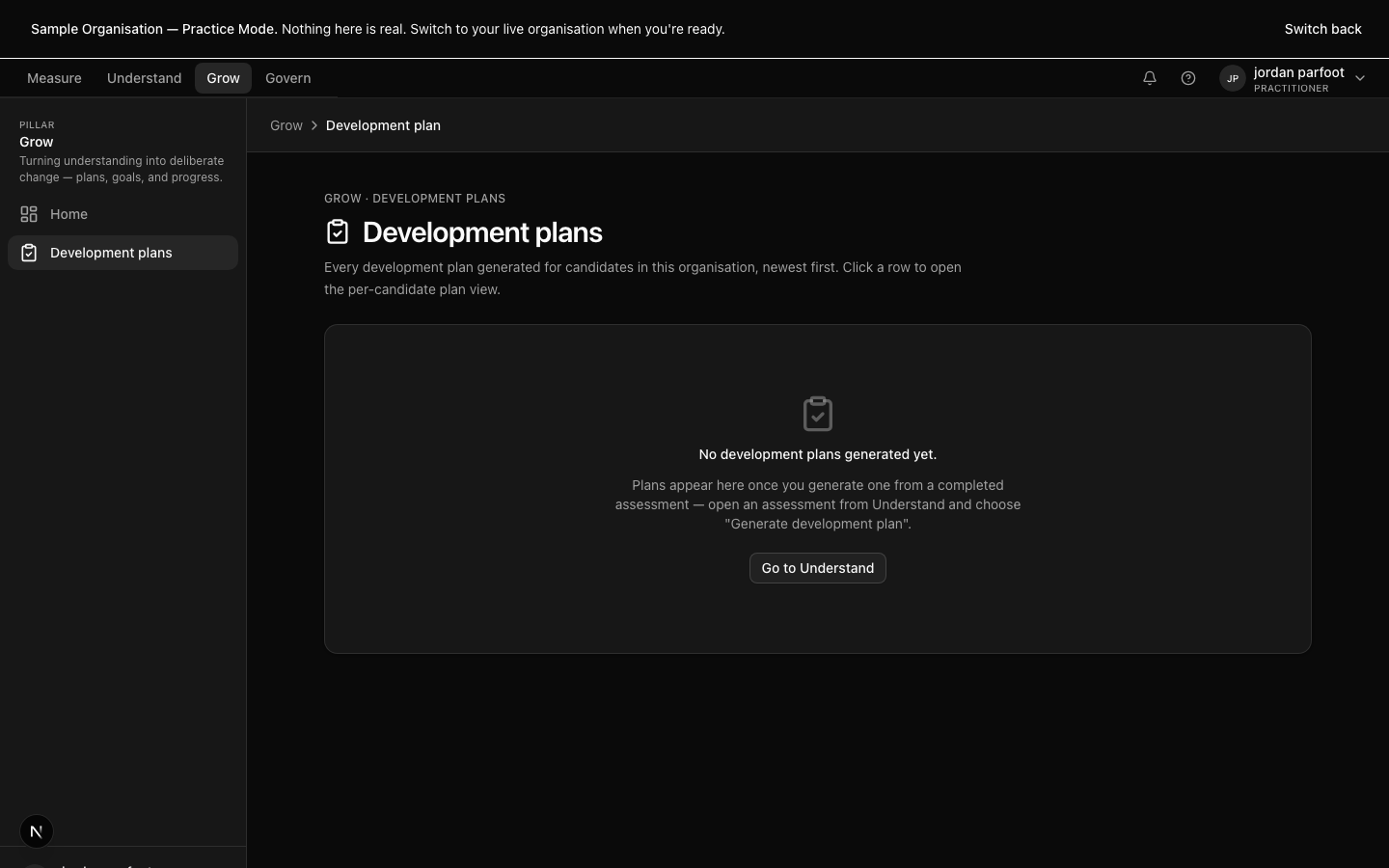
Development plans — 70/20/10 plans anchored in evidence and owned by the participant.
My goals

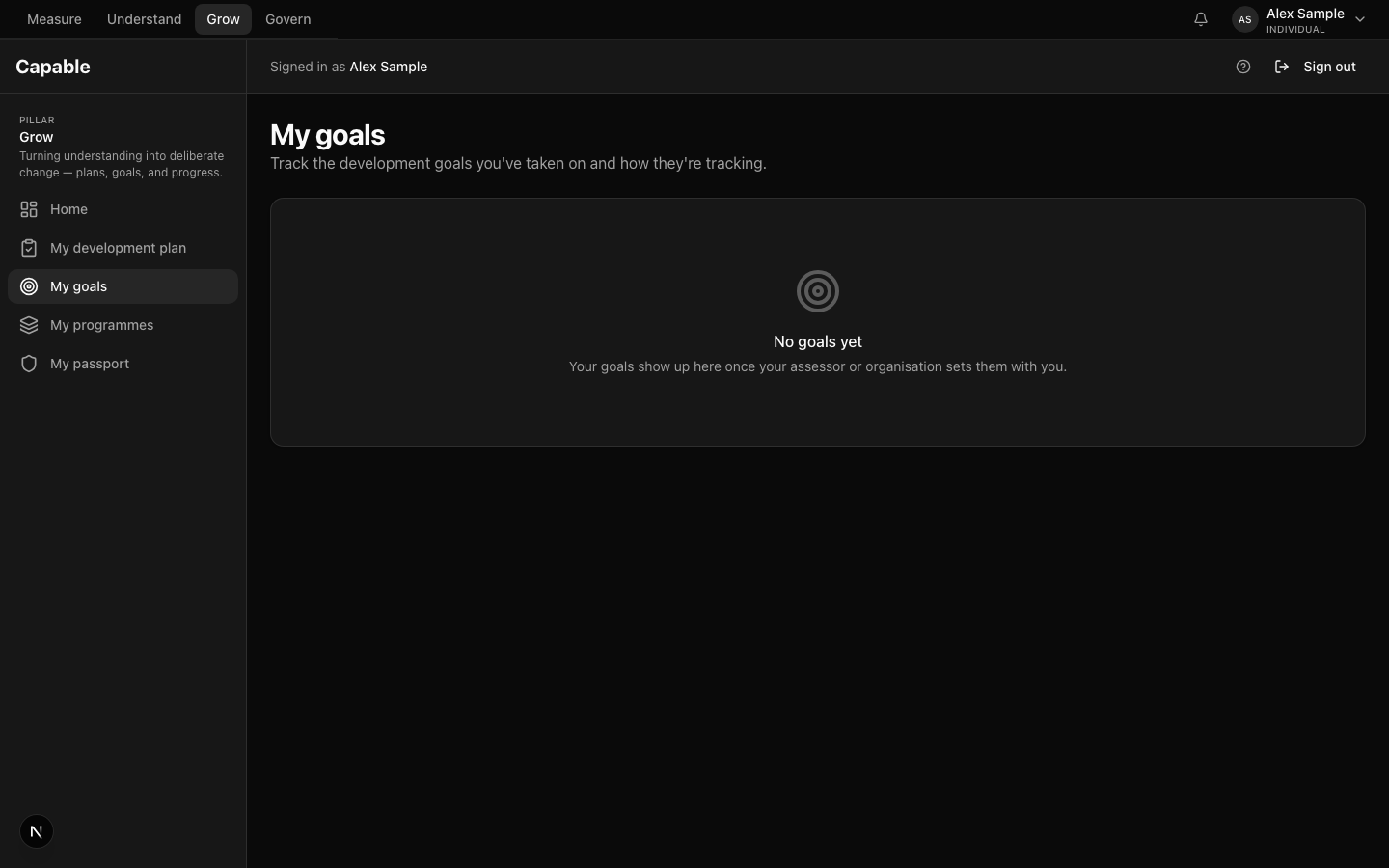
The participant-side view of the plan.

My goals is the participant's surface — the goals they have taken on from the plan, the next step on each one, the re-measurement points marked on the timeline. The participant can add a note, mark progress, or flag a goal they need to renegotiate with their practitioner.

The participant owns this surface. The practitioner sees it from their side; nobody else does unless the participant explicitly shares.

My goals — The participant-side view of the plan.

My goals — The participant-side view of the plan.

Recommendations

Learning resources matched to a skill and a level.

The recommendations engine matches the participant's gaps and goals to a library of partner content, internal modules, and reading. Attribution travels with every item — the participant always sees who produced the resource and how it was selected.

Recommendations is pull, not push. The participant chooses what to take on; the platform doesn't auto-enrol or auto-schedule. The intent is to surface the right options, not to take over the development conversation.

Recommendations — Learning resources matched to a skill and a level.

Recommendations — Learning resources matched to a skill and a level.

Skills Passport

A signed, portable record of what the participant has shown.

The Skills Passport is the participant's own artefact. It carries the skills they've been rated against, the levels they've reached, the instruments those ratings drew on, the consent envelope that governed each, and an HMAC signature the participant can hand to a receiving organisation.

The passport translates across frameworks — SFIA-9 codes map to ESCO and O*NET equivalents, with a published confidence level for each translation. The participant keeps the key; sharing is per-recipient. Issued passports show how often each recipient has verified.

Skills Passport — A signed, portable record of what the participant has shown.

Skills Passport — A signed, portable record of what the participant has shown.

Passport verification

The public surface that confirms a passport's signature.

The passport verifier lives at a public URL — a receiving organisation lands there with the passport reference and confirms the signature, the framework translation, and the consent scope of what they're being shown. The verifier does not require an account.

The verifier surface is built for cold arrival. Plain language, no jargon, a one-page explanation of what a verified passport is and what it isn't. A receiving organisation doesn't need to be a Capable customer to read it.

Passport verification — The public surface that confirms a passport's signature.

Passport verification — The public surface that confirms a passport's signature.

Longitudinal progress

Movement against goals over time, with re-measurement points marked.

Longitudinal progress is the participant's growth, plotted. Each goal carries its own timeline; re-measurement points are marked; the deltas the platform measured are visible alongside the participant's own notes.

This surface is the evidence base for the conversation at a review point. Did the plan close the gap, or did it not. The platform's job is to make the answer visible, not to argue either side.

Longitudinal progress — Movement against goals over time, with re-measurement points marked.

Longitudinal progress — Movement against goals over time, with re-measurement points marked.

Programme outcomes

Aggregated pre/post change across cohorts and programmes.

Programme outcomes aggregates the deltas the platform measured across every participant in a programme. A leadership programme that pre/posted the 360 produces a cohort-level delta. A graduate cohort that pre/posted cognitive and AISA produces two cohort-level deltas.

Outcomes are surfaced honestly. A cohort too small for a meaningful delta is labelled as such; a delta inside the noise of the instrument is named accordingly. The platform refuses to surface false signal as growth.

Programme outcomes — Aggregated pre/post change across cohorts and programmes.

Programme outcomes — Aggregated pre/post change across cohorts and programmes.

When to use which destination

Grow surfaces work backwards from what you're trying to move — the plan, the goal, the resource, the proof.

I need to draft or review a development plan for one person.
Open Development plans.
I'm an individual tracking my own work.
Open My goals and My progress.
I need to find learning resources mapped to a skill.
Open Recommendations.
I want to see longitudinal change across a cohort.
Open Longitudinal progress or Programme outcomes.
I'm reporting whether a capability gap closed.
Open Capability gap closures.
I'm sharing a verified credential externally.
Open My passport (participant) or Issued passports (organisation).

How this pillar connects to the other three

Grow draws on Understand: the development plan starts from the report's rating evidence, not from a blank page. Grow triggers Measure: a re-measurement scheduled in a plan returns the participant to a Measure session, which is how the loop closes. Govern envelops Grow: the consent shape for a Skills Passport, the sign-off on a development plan that goes into an external personnel record, the audit trail for how a recommendation was generated — all of those sit in Govern.

See it live

We'll walk you through the surfaces above on a deployment that matches your sector.