Org-blind oversight of high-stakes capability decisions.
The Trust & Safety role is accountable for the platform operating fairly and safely inside your organisation. Capable gives that role its own surface, its own metrics, and its own sign-off authority — distinct from HR, distinct from leadership.
The Trust & Safety landing page — five-question tile layout with current status against each question.
What Capable does for the Trust & Safety role
After sign-in, the T&S role lands on a distinct surface at /trust-safety. The landing answers five questions in a tile-based layout, in this order: is the platform operating, are people being treated fairly, is consent being respected, are appeals being heard, is anything anomalous right now. Each tile shows a current status, an anchored band, and a one-click drill-in to the detail. The five questions are the work of the role.
Every governance metric ships with a plain-language band — typical, worth a look, investigate — and a one-paragraph explanation of what causes drift in that direction. The bands are honest, not red/green: a metric in the 'investigate' band is a signal worth your attention, not a verdict. Where bands rest on cross-organisation reference data the platform does not yet have, they are anchored to synthetic, research-derived ranges and labelled as such.
On the quarterly cadence, the T&S role signs the governance report in-platform. The report is signed with HMAC-SHA256 and chained to the previous quarter — a tamper-evident record of the platform's safety posture over time. The artefact is what the T&S role hands to the audit committee, the external regulator, or the board as evidence the platform was operated within its commitments for the period.
A typical journey
What the first quarter usually looks like for a T&S owner stepping into the role for the first time.
- Day 1
Orientation to the five-question landing
You're not running assessments. The first task is to understand what the landing tells you and what each metric means. Tour copy on day one frames each tile as a real question, not as a feature. You spend the day reading the anchored bands and the explanations of what causes drift — not chasing anomalies.
The single most important thing. The five questions are the work. Reading the bands well comes before acting on them.
- Week 1
Building intuition about the metrics
By week one you start to develop a feel for what counts as normal variance in practitioner consensus, what level of fairness signal warrants a closer look, what appeal volume is healthy. Anchored bands give you the benchmark to read. The platform does not push notifications at you in the first days; you come to the surface when you choose.
The single most important thing. Anchored bands carry you over the cold-start problem. You read against typical / worth a look / investigate, not against a colour.
- Month 1 (quarterly cycle)
Quarterly governance review
The platform produces a structured fairness and governance review covering what was measured, what consent was given, what was signed off, where consensus diverged, where appeals were upheld, and what sector posture applied. You read it, you sign it in-platform, and the HMAC-SHA256 signature chains the report to the previous quarter. The artefact is what you hand to the audit committee or the external regulator.
The single most important thing. You are a first-class signing authority. The quarterly report is signed by you, not on your behalf.
What you see, and what you don't
The T&S role is cohort-blind. You see governance signals across the platform, not individual evidence — that is the design.
What you see
- Aggregate fairness metrics — per-attribute disparate impact and counterfactual audit results today, with equalised odds and calibration joining as the outcome corpus accrues.
- Instrument health — drift, reliability flags, contested-rating rate by instrument.
- Consent ledger — every consent grant, every revocation, every layered choice, in one auditable place.
- Appeals and contests volume, outcomes, and time-to-decision.
- Sector posture configuration and the audit log of changes to it.
- The AI provenance ledger and the audit trail beneath it.
What you don't see
- Individual evidence — you are cohort-blind by design.
- Practitioner-specific ratings unless your organisation has promoted you into that scope explicitly.
- Business outcome data — that sits with HR and organisational leadership.
- Identified participant data, including names attached to specific ratings.
Cohort-blindness is the design, not an oversight. Where investigation requires identifiable data, the platform's audit pathway records the unmask and the rationale.
The surfaces you'll use
Five of the surfaces the T&S role touches most — the five-question landing, fairness, the quarterly governance report, sector posture, and the audit log.
The Trust & Safety landing page — five-question tile layout with current status against each.
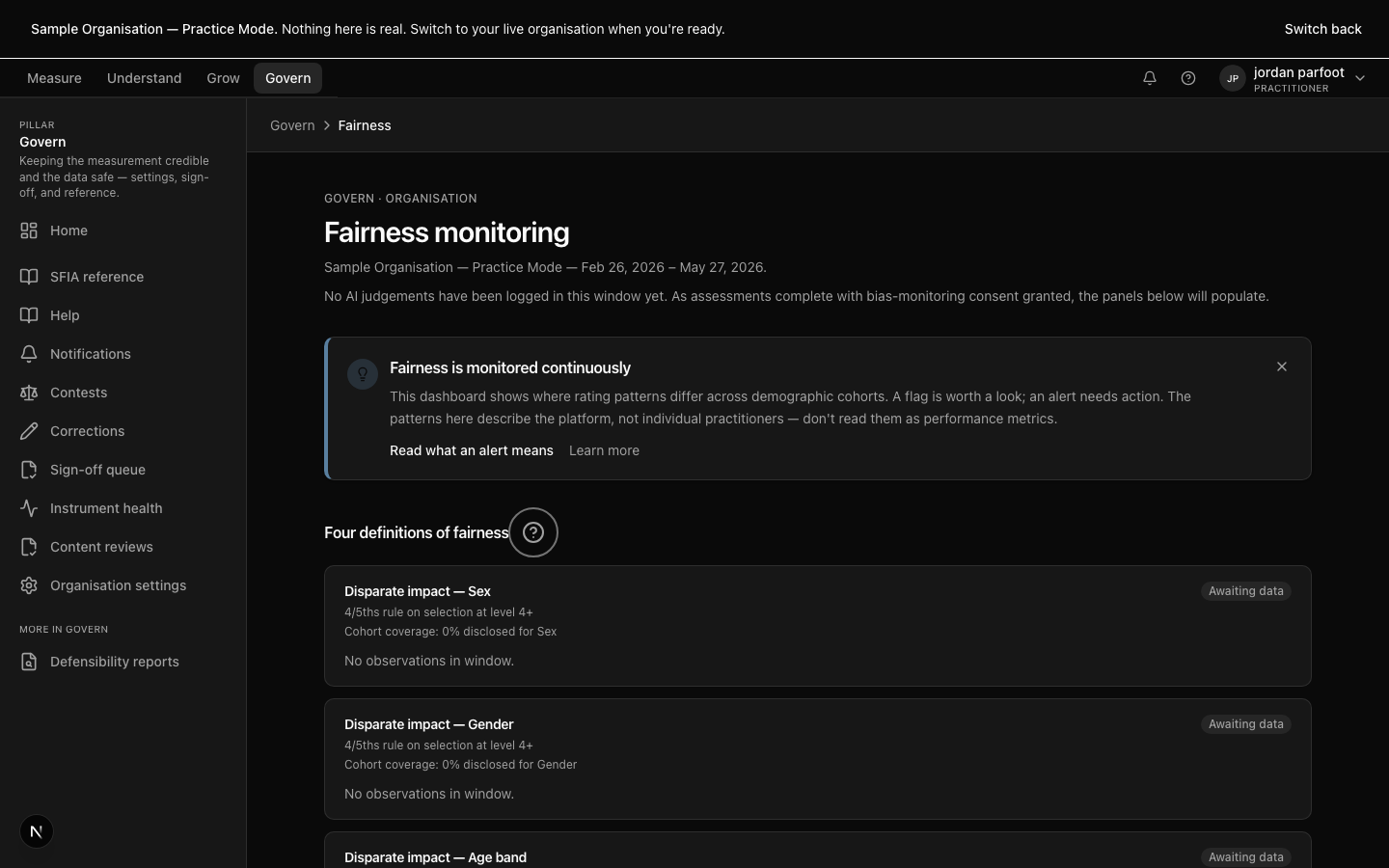
The fairness monitoring dashboard — per-attribute bias signals over time with anchored bands.
The quarterly governance report signing surface — review-and-sign with HMAC-SHA256 immutability.
The sector posture surface — current sector overlay, audit log of changes, threshold configuration.
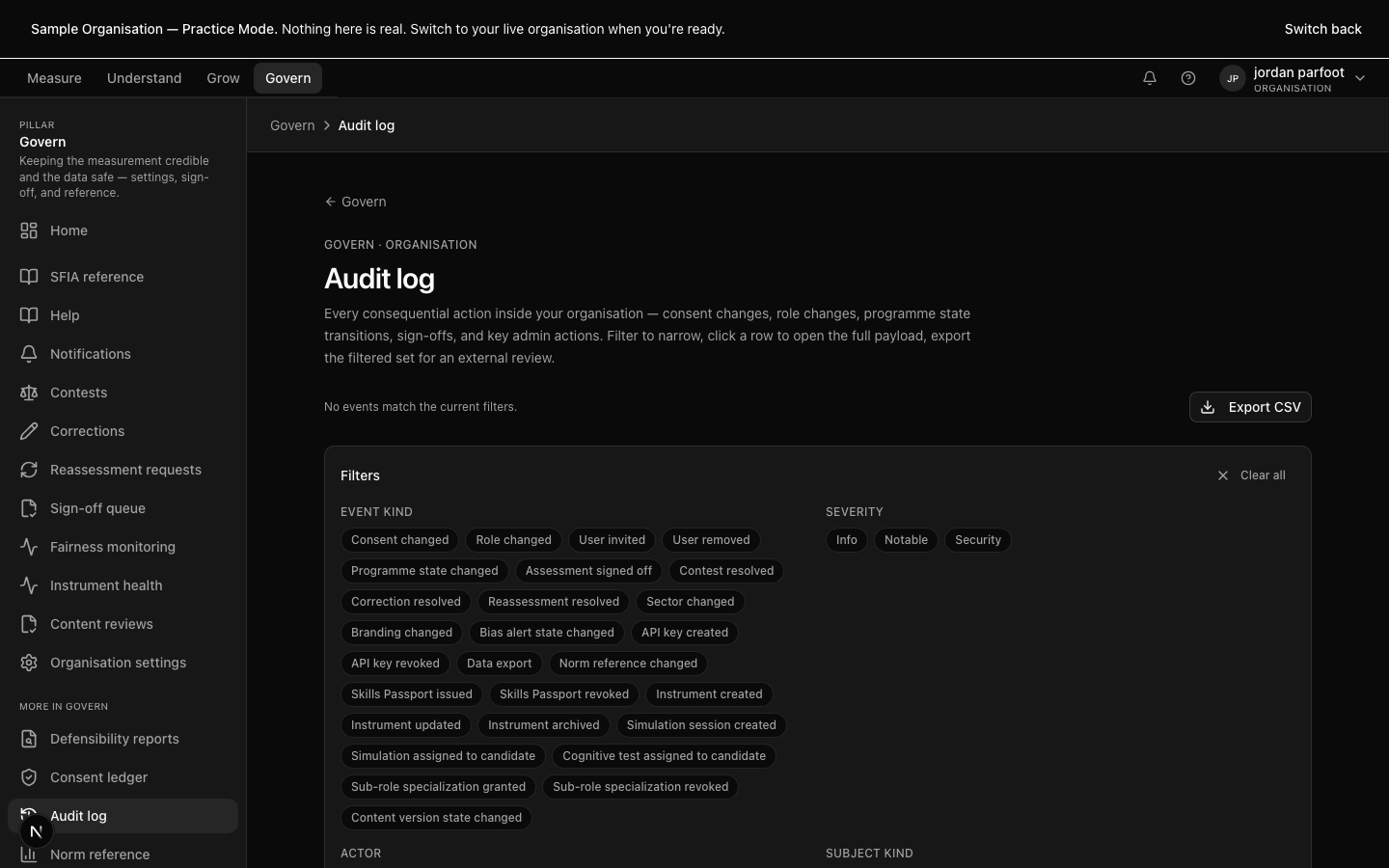
The audit log — hash-chain record of consequential actions across the platform.
What's mature today and what's still developing
Honesty is part of the role. It applies to the platform's self-description too.
Mature today
- The five-question landing surface.
- Fairness monitoring with sector-tuned thresholds and anchored bands.
- Quarterly governance report signed by the T&S role with HMAC-SHA256 chaining.
- Seven sector overlays with platform-managed defaults and a full audit log of changes.
- Hash-chain audit trail across consequential actions.
Still developing
- Counterfactual audit at scale — periodic re-runs are operational; continuous counterfactual coverage is on the roadmap.
- Real cross-organisation benchmark ranges — anchored bands today rest on synthetic, research-derived ranges labelled as such.
- External-regulator-facing export formats beyond the quarterly governance report.
Talk to us about the T&S role
We walk through the T&S surfaces on a sandbox configured to your sector. The role is distinct from the HR view; the walkthrough reflects that.